



How to Keep a Gaming PC Dust Free: Cleaning and Care Guide
The short answer: keep the PC off the floor, give it room to breathe, shut it down when you are not using it, and blow it out with a can of compressed air when you see dust building up. There is no set interval: go by what you see on the front of the case and on top of the graphics card. This guide covers the cleaning steps, fan speeds, whether to switch off at night and how to look after a liquid cooler. It is written by Ginger6, building PCs by hand in Wolverhampton since 2001 and supporting owners across the UK.
If your PC is one of ours and something is not right, skip the guide and call Kevin on 01902 714533. Lifetime technical support comes with every Ginger6 build.
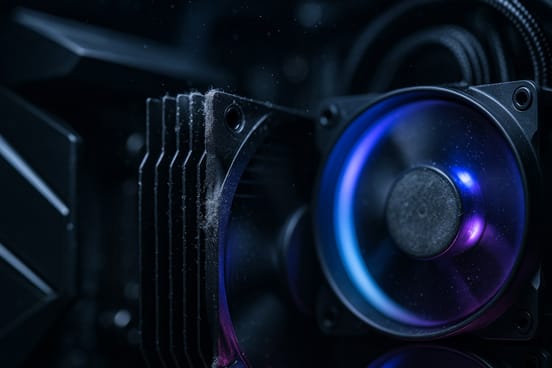
What Dust Does to a Gaming PC
A gaming PC is cooled by air. Dust gets in the way of the air, and four things follow.
Higher Temperatures
Dust sits on heatsink fins and fan blades like a blanket. The processor (CPU) and graphics card (GPU) run hotter, and once they reach their limit they slow themselves down to cope. In a game you see it as a lower frame rate.
Louder Fans
When less air gets through, the fans spin faster to make up for it. A PC which was quiet when new and now roars under load is usually a dusty PC. Fan noise creeping up is the earliest warning you get.
Shorter Component Life
Heat is what ages electronics. A graphics card, power supply (PSU) or motherboard kept hot for months wears faster than one kept cool. Fifteen minutes with a can of compressed air costs far less than a replacement part.
Crashes and Shutdowns
A PC protects itself by switching off when it overheats. If yours shuts down or restarts part-way through a long session, and it never used to, check for dust before you suspect a faulty part.
Gaming PC Maintenance: What to Do and When
These dust prevention tips for gaming PCs apply to any desktop. How often to clean depends on the room. We see PCs come back after years with hardly any dust in them, and others thick with it after a month.
Every Ginger6 PC is hand-built and stress-tested for 24 hours at our workshop in Wolverhampton, with the cabling routed clear of the airflow. If you want a machine built this way, start with a custom gaming PC.
How to Clean a Gaming PC Safely
This routine is how you keep a gaming PC dust free. It takes 15 minutes and one can of compressed air. It is the same advice Kevin gives on the phone.
-
1. Switch it off. Shut Windows down, then flick the switch on the back of the power supply to off.
-
2. Disconnect it from the mains. Pull the mains lead out. Unplug the monitor, keyboard and mouse too if you are going to move the PC.
-
3. Move it away from carpet. Take the PC to a room with no carpet, such as the kitchen, or take it outside. Walking on carpet builds up static electricity in you, and static damages computer parts. If the PC is dusty, outside is the place for it, because the dust has to go somewhere.
-
4. Take off the one removable side panel. It is the panel you took off when the PC arrived, to lift out the protective foam bag. Leave the opposite panel alone. It covers the cabling and carries warranty seal stickers, and it must stay on.
-
5. Keep your hands off the components. With the panel off, touch nothing inside. The air does the work.
-
6. Blow it out with a can of compressed air. Short bursts, with the can held upright so no liquid sprays out. Work over the vents, any filters, the fans, the cooler and the top of the graphics card until no more dust comes away.
-
7. Give it five minutes. Let the dust settle and anything left by the air duster evaporate before power goes back on.
-
8. Connect it all back up. Put the side panel back on. Make sure the monitor cable goes back into the graphics card and not the motherboard. On a Ginger6 PC a sticker with arrows on the back shows where it goes. Plug it into the wrong one and you get a blank screen or poor performance in games.
When to do it: when you see dust. Look at how much is building up on the vents and filters and on top of the graphics card, and clean when it shows.
Do not touch or remove any component to clean it, and never clean a PC in a carpeted room. Not the graphics card, not a fan, not the cooler, not the memory. Compressed air reaches everything it needs to. On a Ginger6 PC, anything you remove, add or change affects the warranty, so call Kevin on 01902 714533 first.
The same can of air is right for clearing dust from the rest of your gaming gear: keyboard, mouse and headset.
Do Lower Fan Speeds Reduce Dust in a PC?
Yes, a little. Less air through the case means less dust carried in with it. It is the weakest of the levers you have, and the wrong one to pull if the price is a hotter PC.
Do Lower Fan Speeds Reduce Dust Accumulation in a PC Case?
Slower fans pull in less air, so less dust arrives. A gaming PC already does the sensible version of this on its own: the fans turn slowly while it idles on the desktop, which is most of the day, and speed up only when a game heats things up.
Do not slow the fans down to keep dust out. Where the PC sits and how long it is left running matter far more, and they cost you nothing in temperature.
Does Shutting Down a PC Reduce Dust Buildup?
Yes. Dust gets in because the fans draw room air through the case. Fans which are not turning draw nothing. A PC left idling overnight pulls air through for eight hours with nobody using it.
Shut down at night and you cut the hours of airflow by a third or more.
How to Stop Dust Flying Around the Room From a Computer
The exhaust fans blow air out of the back and top of the case, and the air stirs up whatever dust is lying nearby. Clean the PC outdoors so the dust inside it leaves the house. Keep the floor and desk around it vacuumed.
Lift the PC off carpet and leave 10cm clear behind it. If the room is dusty by nature, a small air purifier near the desk helps the PC and you.
Why some PCs collect less dust than others: the case. Some cases have dust filters built in and some do not, and how the fans are arranged decides how much unfiltered air gets pulled in through the gaps. It is settled when the PC is built and is not something to change afterwards. If dust is a worry in your house, tell Kevin when you order and he will choose a case to suit. Our airflow guide explains fan layout in full.
The best way to avoid dust in a PC is to keep it away from where dust collects. A clean PC is a quieter PC too. Four habits: keep the PC on the desk, away from radiators and sunny windows, with space around the vents, and keep pets from sleeping against the front panel.
Should You Leave a Gaming PC On All Day?
No. Our advice is to switch a desktop off completely when you have finished with it. Sleep and hibernate are for laptops. Leaving a PC on all day does it no harm in itself, and a healthy PC will run for weeks without a break. You gain nothing by it, and it costs you three ways.
-
Electricity. The cost depends on two things: what your PC draws at idle, and how many hours a day it sits idle. Take a mid-range gaming PC idling at 80 watts and left on for 16 unused hours a day. Over a year it uses about 467 kWh. At around 25p per kWh the bill is roughly £117 for nothing. For your own figure: watts at idle, times idle hours a day, times 365, divided by 1000, times the unit rate on your bill.
-
Dust and fan wear. Every hour the fans turn, they pull dust in and use up bearing life.
-
Windows gets sluggish. Programs left open for days hold on to memory. A restart clears it and lets updates finish installing.
The old reasons for leaving a computer on have gone. A PC with a solid-state drive (SSD) starts in well under a minute, and switching on and off does not wear out modern parts. One exception: leave it on if it is doing a job, such as a long download, a render or a backup, then let it shut down afterwards.
Windows offers sleep and hibernate as well as shut down. On a laptop, use them. On a desktop, we advise against both. In 25 years of building PCs we have seen desktops go to sleep or into hibernation and then refuse to come back out, and we do not see it on laptops. We switch sleep and hibernation off on every PC we build, as part of setting it up. So on a Ginger6 PC the choice is between on and off, and at the end of the day the answer is off.
The Rest of a Gaming PC Care Routine
Cleaning is half of looking after a PC. These four points are the other half.
Keep Windows and drivers up to date
Let Windows Update run, and install new graphics drivers through the Nvidia app or AMD Software when a game you play asks for them. Motherboard firmware (the BIOS) is different: leave it alone unless an update fixes a problem you have. Our guide to BIOS settings for a gaming PC build explains which settings matter.
Do not go by temperature
Hot is normal. Top-end processors, the Intel Core i7 and Intel Core i9 chips especially, sit at 80 to 85 degrees Celsius under load, and they are designed to. A temperature reading is no guide to when a PC needs cleaning. Go by what you see and hear: dust on the vents and filters, and fans louder than they used to be.
Look after a liquid cooler
An all-in-one (AIO) liquid cooler is a no-maintenance part. You do not fill it, you do not service it and you do not change the liquid. It does its job. Its radiator collects dust like any other part of the PC, so blow it off when you clean the rest.
Listen to it
You know what your PC sounds like. A new rattle, a fan ticking against a cable or a whine under load is worth acting on. Most noises are a dusty fan, and a blow-out cures them. If the noise stays and the PC is one of ours, call Kevin. Fan noise also changes with the screen you run: a higher resolution works the graphics card harder, which is one reason to match your monitor to the PC.
When Cleaning Is Not Enough
If a clean PC still overheats, something has failed or the PC has aged out. Which of these three fits you?
- Lifetime technical support
- 3-year warranty, unlimited repairs
- Returned from anywhere in the UK
- Keep the original packaging
- Bring it to WV10 9LE
- Diagnosis before any work
- Repairs, cleaning and upgrades
- Local customers only
- Hand-built in Wolverhampton
- Stress-tested for 24 hours
- Cabling routed clear of the airflow
- Free UK mainland delivery
Ginger6 designs and builds custom systems for gaming and for work. If neither a repair nor a gaming PC fits, tell Kevin what you use the machine for and he will spec a custom PC around it.
Common Questions About Dust and PC Care
Yes, slightly. Slower fans move less air through the case, so less dust is carried in. It is a small effect, and running fans too slowly makes the PC hotter. A gaming PC already runs its fans slowly at idle and faster in games, so there is nothing to change. Where the PC sits and how long it is left running make a bigger difference to dust.
Clean the PC outdoors or by an open window so the dust leaves the house, then keep the floor and desk around it vacuumed. The exhaust fans blow air out of the back and top of the case and stir up any dust lying nearby. Lifting the PC off carpet, leaving 10cm of space behind it and blowing the PC out when dust shows all cut the amount of dust it blows about.
There is no fixed interval. It depends on how dusty the room is. Some PCs stay clean for years and others are thick with dust after a month. Look at the vents, any filters and the top of the graphics card every few weeks, and blow the PC out with compressed air when you see dust building up.
Yes. Dust enters a PC because the fans pull room air through the case. When the PC is shut down the fans stop and no air is drawn in. Shutting down overnight removes around eight hours of airflow a day, so the inside stays clean for longer.
No. A household vacuum cleaner builds up static electricity at the nozzle, and static damages memory, graphics cards and motherboards. Use a can of compressed air and nothing else inside the case. A vacuum is fine for the floor and desk around the PC.
No. Leaving a healthy PC on does not damage it, but it wastes electricity, pulls in more dust and lets Windows get sluggish. A gaming PC idling for 16 unused hours a day wastes about 467 kWh a year, roughly £117 at around 25p per kWh. Your own figure depends on what the PC draws at idle and how long it sits idle. Our advice for a desktop is to switch it off completely when you have finished, and to leave sleep and hibernate to laptops.
No. An all-in-one liquid cooler is a no-maintenance part. You do not fill it, service it or change the liquid. It does its job. Blow the dust off its radiator when you clean the rest of the PC.
Not if you clean it the way we advise: switched off, disconnected from the mains and blown out with a can of compressed air. Take off only the side panel you removed to lift out the transit packing. The opposite panel carries warranty seal stickers and must stay on. Do not remove any component. Anything you add, remove or change inside a Ginger6 PC affects the 3-year warranty, so speak to us first on 01902 714533.
More Help Looking After Your PC
Airflow and Cooling
Where the fans go, which way they face and how to tell if your case is short of air.
Read the GuideUpgrade Instead of Replace
Which parts are worth changing in a PC you already own, and which are not.
Read the GuideWant a PC Built to Stay Cool and Quiet?
Every Ginger6 PC is hand-built in Wolverhampton with the cabling routed clear of the airflow, stress-tested for 24 hours and backed by a 3-year warranty. The person who sells it is the person who builds it, and he answers the phone afterwards.