




7500X3D: The Lowest Clock Speed We Fit, and the Cheapest Way Into 3D V-Cache
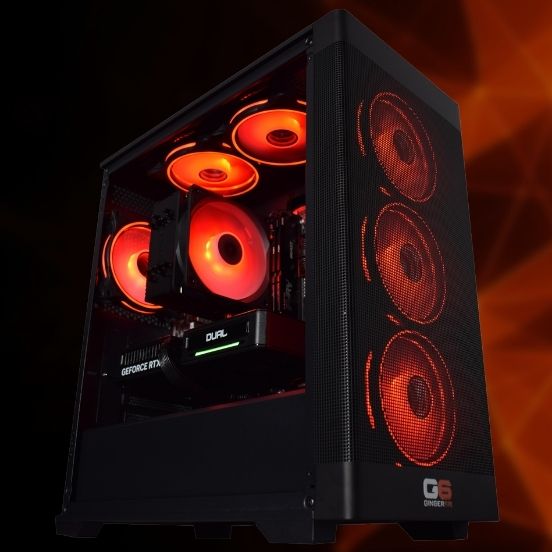
The short answer: the AMD Ryzen 5 7500X3D is six Zen 4 cores at 4.0GHz base and 4.5GHz boost, with 96MB of L3 cache and a 65W power budget on the AM5 socket. That 4.5GHz is the lowest boost clock of the nineteen AMD processors in our Fusion 800 dropdown, and in games it still outruns every faster-clocking Ryzen 5 sitting next to it in the same list, because the cache stops the processor waiting. It is the standard chip in the G6 Apex 1 at £1534.99, and the cheapest machine we would genuinely build around it is the G6 Fusion 600 X4 at £1263.99. If the PC has to do serious work as well as play, do not buy it. Every one is put together by hand in Wolverhampton, tested for a full day, and delivered free to UK mainland addresses.
Kevin fits this processor every week and it is not the right answer for everyone who asks about it. Call him on 01902 714533, tell him the graphics card and the screen you play on, and he will say whether the cache is where your money belongs.
Six Cores, 96MB of Cache, and a Clock Speed That Looks Wrong
Every figure below is lifted off AMD's published specification sheet, and we hold our own dropdown up against it before we quote anything. On this part the two match to the decimal: the option label reads AMD Ryzen 5 7500X3D (6x 4.00/4.50GHz).
96MB of L3, and two thirds of it is a second slab of silicon
AMD publishes the L3 figure as 96MB. That total is the 32MB a Zen 4 six-core complex carries on its own, plus a separate 64MB cache die bonded to it, which is the part the X3D name refers to. Add the 6MB of L2 and the chip holds 102MB of cache altogether. Cache is memory that lives on the processor and answers in a few nanoseconds instead of the hundred or so a trip out to system memory costs. Six cores with 102MB in front of them is an odd-looking specification, and it is the entire reason this processor exists.
4.0GHz base, 4.5GHz boost, and no hiding it
Nineteen AMD processors appear in the dropdown on a G6 Fusion 800, and this one has the lowest boost clock of the lot. The reason is physical: on Ryzen 7000 the cache die is bonded above the cores, so it sits between the hottest silicon and the cooler and behaves like a blanket. AMD caps the voltage and the heat accordingly, publishes a maximum operating temperature of 89C, and lists no unlocked multiplier for the part. EXPO memory profiles, Precision Boost Overdrive and Curve Optimizer are all supported and all set on our bench. Zen 5 turned the sandwich over and put the cache underneath, which is why the newer X3D chips clock higher.
Six cores, twelve threads, and a clear edge
Six cores runs a modern game with a browser, a voice client and a capture overlay open behind it, and it lets a graphics card encode a stream without the game losing frames. What six cores at this clock speed will not do is shorten a video export, a 3D render, a long compile or a batch of raw photographs, because those jobs want cores and megahertz and this chip is short of both. If the machine has to earn a living as well as play, the eight-core Ryzen 7 8700F costs nothing over the base price of a G6 Fusion 800 X2 and the Ryzen 7 9700X is £1372.99 on the same build. Either is the better all-rounder and we would rather point at them here than at the bottom of the page.
65W, a little over half of what the Ryzen 7 X3D parts ask for
AMD rates the 7500X3D at 65W where the Ryzen 7 7800X3D is 120W, so the heat load is genuinely modest and the standard air cooler we fit holds the rated clocks without the fans making themselves heard. AMD puts no cooler in the retail box and recommends liquid for optimal performance, which is the same line it prints on every X3D part; at 65W the liquid options on a Fusion or an Apex 1, £51.00 for a 240mm radiator and £64.99 for a 360mm, are bought for quiet rather than out of necessity. The rest of the platform is standard AM5: DDR5 in two channels rated to DDR5-5200 on a two-module kit, PCIe 5.0 with 24 usable lanes, 128GB of memory supported, and a small Radeon graphics core on the die so the machine still puts a picture on screen with the graphics card removed.
Why 4.5GHz Finishes the Frame Before 5.4GHz Does
Put the two Ryzen 5 chips we sell most of side by side and the specification sheet tells you the wrong thing. The Ryzen 5 9600X boosts to 5.4GHz on newer cores. The 7500X3D boosts to 4.5GHz on older ones, nine hundred megahertz behind. In games the 7500X3D is the faster of the two, and in the titles where it matters it is not close. That deserves a proper explanation rather than a shrug, because it is the one fact that decides whether this is your processor.
Clock speed and cache answer two different questions. Clock speed is how quickly a core gets through a piece of work once the data is in front of it. Cache is how often the data is in front of it at all. Most kinds of computing are decided by the first question. Games are unusual in being decided by the second.
A game engine does not grind through one long calculation the way a video export does. It asks for thousands of tiny things every frame: where each object has moved to, what the physics settled on last tick, what the enemy behaviour decided, which piece of the world comes into view next. If the answer is already sitting in the processor's own cache it arrives almost instantly. If it has to be fetched from system memory the core stops, and that pause is long enough to have run a hundred instructions it could have been getting on with.
So a frame is not one block of work. It is work, wait, work, wait, hundreds of times over. Raising the clock speed makes the work blocks shorter and leaves the waits exactly as they were. Bonding 64MB of extra cache to the chip removes waits. That is why 4.5GHz with 96MB behind it gets to the end of the frame before 5.4GHz with 38MB does, and why the gain shows up most clearly in the numbers people feel rather than the one they quote: the one percent lows, the hitch as a new area streams in, the strategy map that thickens in its third hour.
The honest limit of that argument. Cache only pays while the processor is the part you are waiting for. At 4K on a mid-range card, or at 1080p in a game that leans entirely on the graphics card, the card is still drawing long after the processor has finished its share of the frame, and there this chip and a 9600X hand you the same number. Cache pays at 1080p and 1440p on a high refresh screen, in competitive shooters, in simulators, and in anything carrying a large simulated world behind the picture. If none of that describes your week, the money belongs elsewhere and the rest of this page says where.
None of this makes the 7500X3D a fast processor in the general sense. It is not. Away from games it sits behind chips on this list that cost less than it does.
Every Ryzen 5 in one dropdown, priced in one machine
Six Ryzen 5 processors appear on the G6 Fusion 800 X2, which starts at £1279.99. Nothing changes between these rows except the chip. The clock figures are the labels our own dropdown carries; prices were read live from the configurator on 30 August 2026.
| Processor | Base and boost | Stacked cache | Fitted price |
|---|---|---|---|
| Ryzen 5 8400F | 4.20 / 4.70GHz | None | £1219.99 |
| Ryzen 5 7600X | 4.70 / 5.30GHz | None | £1249.99 |
| Ryzen 5 9600X | 3.90 / 5.40GHz | None | £1267.99 |
| Ryzen 5 9600 | 3.80 / 5.20GHz | None | £1279.99 |
| Ryzen 5 7500X3D | 4.00 / 4.50GHz | Yes, 64MB | £1300.65 |
| Ryzen 5 7600 | 3.80 / 5.10GHz | None | £1301.59 |
Read that table the way a specification sheet would and the 7500X3D is the worst chip on it: lowest boost clock, oldest architecture, second dearest. Read it the way a game does and it is the fastest of the six, and the Ryzen 5 7600 underneath it costs £0.94 more to be slower at everything you bought the machine for. That inversion is the whole argument for this processor, and it holds only for games.
Three Machines, One Graphics Card, £271.00 Between Them
All three of these put the 7500X3D in front of the same RTX 5060, which makes the differences between them unusually easy to read. All three were showing in stock with a live add-to-cart button on the day this was written.
There is a cheaper 7500X3D machine, and it is the one to avoid
You will find it on your own, so here it is. The G6 Fusion 600 X1 starts at £1069.99 and will take the 7500X3D for £1153.99, which is the least anyone can spend to own this processor on our site and £110.00 below the Fusion 600 X4 above. The graphics card in it is an RTX 3050.
Everything on this page rests on the processor being the part you are waiting for. Behind an RTX 3050 it never is. The card is still drawing when the cores have long since finished, so the 64MB of stacked cache has nothing to do and the £84.00 you paid for it changes no number you will ever see. That £110.00 gap between the two machines is exactly the gap between an RTX 3050 and an RTX 5060, and you would notice that one in the first ten minutes. If £1153.99 is genuinely the ceiling, keep the standard Ryzen 5 8400F at £1069.99 and put every spare pound into the card instead. That is the advice you would get on the phone and it costs us £84.00 to write it down.
The 7500X3D also appears further out in both directions. It is an £84.00 option on the AMD and Ryzen 7000 custom builders, which start at £1039.99, so £1123.99 configured, and the same £84.00 on the AMD Workstation builder, which starts at £1054.99. It can be chosen on every G6 Fusion 600 and Fusion 800 build. It also appears as a downgrade on the Apex 2, Apex 3, Apex 3 Radeon, Apex 4 and Sonic FSX3, taking £102.00 off an Apex 2 and £192.00 off an Apex 4, and we would talk you out of both: those machines exist to keep an RTX 5060 Ti or an RTX 5070 Ti busy, and a six-core Ryzen 5 in front of a card that size is the wrong way round. Browse the finished builds on the Ryzen 5 gaming PC page or specify your own on the AMD custom PC builder. Every figure here was read from the live configurators on 30 August 2026, and the current one is always in the dropdown on the product page.
Three Readers Who Should Buy a Different Chip
Each of these costs us money on a real number of orders. They are also what Kevin says on the phone, so they may as well be written down where everyone can read them.
If the Machine Also Has to Work
Six cores at 4.5GHz is a gaming shape and nothing else. Video exports, 3D renders, long compiles, virtual machines and batch photo work all want cores and clock speed, and this processor is deliberately short of both.
Buy instead: the eight-core Ryzen 7 8700F, standard on a G6 Fusion 800 X2 at £1279.99 with nothing to add, or the Ryzen 7 9700X at £1372.99 on the same machine for the newer cores. Both are better all-rounders than this one and one of them is cheaper.
If the Budget Will Stretch a Hundred Pounds
The Ryzen 7 7800X3D is the same stacked-cache trick with two more cores and 500MHz more boost clock. On the Fusion 800 X2 it is £1403.59 against this chip's £1300.65.
Take it if: you stream, record or edit alongside gaming, or you want the machine to still be the right answer in five years. On the G6 Apex 1 the same step costs £102.00 and lands at £1636.99. If finding that money means a smaller graphics card, stay here instead.
If You Play Casually on a Modest Card
The Ryzen 5 8400F is the standard processor on all six G6 Fusion 600 builds and on all three custom builders, at no cost at all, so the £1179.99 Fusion 600 X4 stays £1179.99.
Stay there if: you play at 1080p on a 60Hz to 144Hz screen behind an RTX 3050, an RTX 5050 or an RTX 5060 and nothing you play is a competitive shooter or a simulator. The card is what you are waiting for, so the cache has almost nothing to do. Saying that loses us the upsell on a fair number of orders and it is still the right answer.
Want someone to decide it for you? Call Kevin on 01902 714533 or email [email protected] with four things and he will name the processor and the machine to put it in, including the times the answer is a cheaper one:
1. The two or three games that take up most of your playing time. 2. The screen in front of you, its resolution and how many hertz it runs at. 3. Whether the PC has a second job: rendering, exporting, compiling or encoding. 4. What you would rather not go over.
Happier choosing the parts yourself? The AMD custom PC builder carries every processor named on this page. 0% finance available via PayPal Pay in 3 on orders over £500. Subject to status.
The Cheapest Real Gaming Processor We Fit, and What That Sentence Is Worth
AMD's stacked cache has been the right answer for gaming since 2022 and, for most of that time, an expensive one. It arrived on Ryzen 7 and Ryzen 9 parts, in machines built around them, at prices that put it out of reach of the person buying a first proper gaming PC. The 7500X3D is the first time it has come down to the bottom of a Ginger6 dropdown. On a G6 Fusion 600 it is an £84.00 line item. On a G6 Fusion 800 it is £20.66. Those are small enough numbers that the decision stops being about money and starts being about what the machine is for, which is a much better conversation to have.
The claim in the heading needs defending, because "cheapest" is easy to say and easy to get wrong. On our own list the 7500X3D is the least expensive processor carrying stacked cache, and the next one up, the Ryzen 7 7800X3D, is £102.94 further on in the same machine. There are five cheaper processors on that Fusion 800 dropdown and every one of them is quicker than this chip at something. None of them is quicker at running a game. That is a narrow claim, deliberately, and it is the only one this page makes.
Where the saved money should go, and it is not subtle. Our own price list makes the point better than an argument could. A G6 Fusion 600 X1 with an RTX 3050 is £1069.99 and a G6 Fusion 600 X4 with an RTX 5060 is £1179.99. The whole distance between an entry card and a properly capable one is £110.00, which is roughly what people talk themselves into spending on a processor upgrade they will not be able to measure. If your budget is somewhere near this chip and the card in the basket is small, move the money. Then come back for the cache when the card no longer needs it.
What we do to one of these once you have chosen it. At 65W the cooling question is easier than on the Ryzen 7 X3D parts, so the standard air cooler holds the rated clocks and stays quiet doing it, and the liquid options at £51.00 and £64.99 are there for silence rather than survival. Memory goes into a Fusion build as 16GB DDR5 5200MHz (2x8GB) Dual Channel and into a G6 Apex 1 as 32GB DDR5 5200MHz (2x16GB) Dual Channel, always a matched pair and never one module, because a single stick leaves the processor with half the memory bandwidth it was designed around, and on a chip whose entire argument is about not waiting for memory that would be a strange corner to cut. The EXPO profile is switched on and proved on the bench rather than left dormant for you to find. The board is a Gigabyte A620M H with Wi-Fi via the included USB adapter, and if you want Wi-Fi 6E and Bluetooth on the motherboard itself, a B650M D3HP AX is £54.00 in the same dropdown. The finished machine then runs for a full 24 hours under load in the Wolverhampton workshop, which is where a marginal part or a lazy cooler mount declares itself rather than at your desk a month later.
Two questions this page deliberately leaves alone. If what you are really weighing is Intel against AMD at this level rather than which Ryzen 5, our guide to whether an i5 is better than a Ryzen 5 for gaming takes that apart properly and we are not going to re-run it here. If you want the rest of the generation this chip belongs to, the Ryzen 7000 guide covers what Zen 4 and AM5 changed and which of those processors are still the default in machines we build today.
Kevin has been building these machines since 2001, assembles every one himself in Wolverhampton and answers 01902 714533 in person. A call about a machine still inside its 3-year warranty reaches him and not a ticket queue, which is most of the reason the Trustpilot score sits at 4.9 across more than 1100 reviews. UK mainland delivery costs nothing. And where the truthful answer to your question is a cheaper processor, a larger graphics card or keeping the machine you already own, that is the answer you will get.
Common Questions About the Ryzen 5 7500X3D
The Ryzen 5 7500X3D is a six-core, twelve-thread desktop processor AMD launched on 12 November 2025. It is a Zen 4 part, codename Raphael, running at a 4.0GHz base and up to a 4.5GHz boost, and it carries 96MB of L3 cache: the 32MB a six-core Zen 4 complex holds on its own plus a 64MB cache die bonded on top of the cores, which is what the X3D name means. Counting the 6MB of L2 there is 102MB of cache on the chip. It draws 65W, has a maximum operating temperature of 89C, fits the AM5 socket with DDR5 memory and PCIe 5.0, and includes a small Radeon graphics core for display output. It is the least expensive processor with stacked cache that Ginger6 fits.
Because of where the extra cache sits. On the Ryzen 7000 generation the 64MB cache die is bonded to the top of the cores, so it lies between the hottest silicon and the cooler and insulates it. AMD limits the voltage and heat the part will accept to protect that stack, publishes a maximum operating temperature of 89C rather than the 95C its non-stacked siblings run to, and lists no unlocked multiplier for it. What is available is EXPO memory profiles, Precision Boost Overdrive and Curve Optimizer, and we set all three on the bench. The Zen 5 generation moved the cache underneath the cores instead, which is why the newer X3D processors clock considerably higher. The low number is real, it is the price of the cache, and in games the cache is worth far more than the clock speed it costs.
In games, yes, despite boosting 900MHz lower on a generation older architecture. Clock speed decides how fast a core gets through work it already has; cache decides how often it has that work in front of it. A game engine asks for thousands of small pieces of data every frame, so the time lost waiting for system memory matters more than the time spent computing, and 96MB of L3 removes far more of that waiting than 38MB does. The gap is widest in competitive shooters, simulators and large simulated worlds, and it shows up most in the one percent lows people feel as stutter. Where the 9600X catches up is everything that is not a game, and at 4K on a mid-range graphics card, where the card finishes long after the processor and both chips give the same result. On a G6 Fusion 800 X2 the 9600X is £1267.99 and the 7500X3D is £1300.65.
One machine carries it as standard: the G6 Apex 1 with an RTX 5060 at £1534.99, which pairs it with 32GB DDR5 5200MHz (2x16GB) Dual Channel, a 1TB M.2 NVMe drive and an ARGB air cooler. Everywhere else it is a line in the processor dropdown. On the G6 Fusion 600 range and on all three custom builders it costs £84.00, which puts the Fusion 600 X4 at £1263.99 and the AMD custom builder at £1123.99. On the G6 Fusion 800 range it costs £20.66 over the base build, putting the Fusion 800 X2 at £1300.65. It also appears as a downgrade option on the Apex 2, Apex 3, Apex 3 Radeon, Apex 4 and Sonic FSX3, which we would not recommend, and it is not offered on the Fusion 1200 range or on the Apex 5 and Apex 6 at all.
The sensible range is £1263.99 to £1534.99, and all three machines in it carry the same RTX 5060. The G6 Fusion 600 X4 configured with this processor is £1263.99, the G6 Fusion 800 X2 is £1300.65, and the G6 Apex 1 with the chip fitted as standard and the memory doubled to 32GB is £1534.99. A cheaper route does exist, since the G6 Fusion 600 X1 will take it at £1153.99, and we would steer you off that one because it puts a cache-heavy gaming chip behind an RTX 3050 that cannot make use of it. Every one of those prices includes free UK mainland delivery, a 3-year warranty and a 24-hour stress test before the machine is boxed.
For playing games on a mainstream graphics card at 1080p or 1440p, six cores with this much cache is enough and the money saved does more in the graphics card. Pay the extra if the machine has a second job. The Ryzen 7 7800X3D is the same cache design with eight cores and 500MHz more boost clock, and on a G6 Fusion 800 X2 it is £1403.59 against £1300.65, a difference of £102.94. On the G6 Apex 1 the same step is £102.00 and takes the build to £1636.99. Take it if you stream, record or edit alongside gaming, or if you want the machine to still be right in five years. Do not take it if finding the money means dropping to a smaller graphics card, because above 1080p the card sets your frame rate.
No. AMD rates it at 65W, a little over half the 120W of the Ryzen 7 7800X3D, so the standard air cooler fitted to a Fusion build or a G6 Apex 1 holds its rated clocks with the fans sitting low in their curve. AMD ships no cooler in the retail box and prints a recommendation for liquid cooling on every X3D part, which matters if you are buying the chip on its own and makes no practical difference when we are building the machine. The liquid upgrades in the dropdown are £51.00 for a 240mm radiator and £64.99 for a 360mm, and on this processor they are bought for quiet and for looks rather than because the heat demands them. One point worth knowing: stacked cache concentrates heat into a small area, so the cooler mount and the fan curve matter more than the wattage suggests, and both are set and confirmed on our bench.
Three years as standard, with longer parts cover available at checkout. The machine is assembled by hand in the Wolverhampton workshop, the memory goes in as a matched pair with its EXPO profile enabled and proved, the cooler mount and fan curve are set for the chip that is in the case, and the finished PC is put under load for a full 24 hours so that a marginal component gives up here rather than in your front room. UK mainland delivery costs nothing, more than 1100 reviews put the Trustpilot score at 4.9, and the number printed on your invoice rings the bench the machine was built on.
The Chips Either Side of This One
One has more cores and the same cache, one has a higher clock and none, and one costs nothing at all. If the question underneath yours was Intel against AMD, our guide to whether an i5 beats a Ryzen 5 for gaming settles that one on its own terms.
Ryzen 7 7800X3D
Eight cores and 500MHz more clock with the same stacked cache, £102.94 above this chip on the same machine.
Read the GuideRyzen 5 9600X
Newer cores, 900MHz more boost, no stacked cache, and £32.66 less on the Fusion 800 X2. The chip this page argues with.
Read the GuideRyzen 5 8400F
The six cores that cost nothing on a Fusion 600, and an honest account of what the £84.00 saving gives up.
Read the GuideReady to Build Around the 7500X3D?
One machine ships with it and the rest of the Fusion range will take it in the dropdown. Whichever you pick, it is assembled by hand in Wolverhampton, held under load for a full 24 hours before packing, and covered for three years. Want a second opinion before you commit? Ring the workshop. You will get one, including the times it points you at a cheaper chip.