




AMD Ryzen 5 9600: What This Chip Does, and Whether It Is Enough
If a specification list sent you here, this is the processor in it. The Ryzen 5 9600 is six Zen 5 cores at 5.2GHz with 38MB of cache and a 65W power budget, and across the G6 Fusion 800 range it costs nothing over the price on the label: £1279.99 with an RTX 5060, £1354.99 with an RX 9060 XT, £1389.99 with an RTX 5060 Ti. Nobody is trying to sell you an upgrade here. The one thing you should know before you order is that the Ryzen 5 9600X sits in the same dropdown at £12.00 less for 200MHz more clock speed, so where both are offered, take the X. Hand-built in Wolverhampton, free UK mainland delivery.
If you are part way through configuring a Fusion 800 and the processor list has stopped you, that is the call Kevin takes most often. Ring 01902 714533 and read him the games and the monitor, and he will tell you which row to pick.
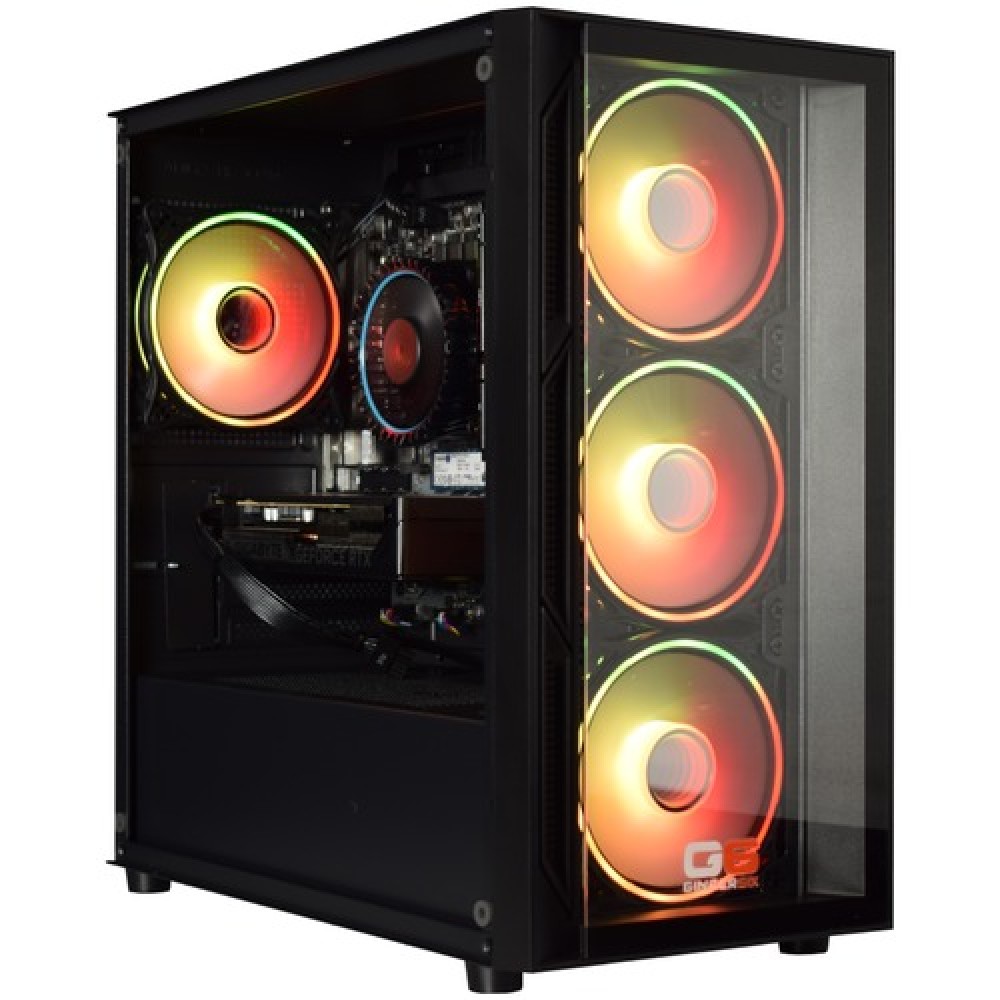
Is It Enough? Here Is What It Runs, and Where It Runs Out
Three kinds of use and a plain verdict on each. No frame-rate charts, because the number that decides whether you are happy is not the processor's speed, it is whether the processor is the part that runs out first. On the machines this chip goes in, it usually is not.
1080p, 60Hz to 165Hz
This is the resolution the chip was made for and it is not close to being stretched. Paired with the RTX 5060 in a G6 Fusion 800 X2, the graphics card decides the frame rate in every mainstream title and the 9600 keeps up without being asked to work hard. Competitive shooters run at the sort of numbers a 144Hz or 165Hz panel can use.
Where it changes: a 240Hz screen and a competitive title. There the processor becomes the limit and cache is what fixes it.
1440p, 60Hz to 144Hz
Moving up to 1440p asks more of the graphics card and slightly less of the processor, because each frame takes longer to draw. With the RX 9060 XT in a Fusion 800 X1 or the RTX 5060 Ti in a Fusion 800 X3, the card is the part doing the work and the 9600 is comfortably ahead of what it needs to be. This is the pairing most people on this page will end up buying.
Where it changes: a larger card. Above an RTX 5070 the balance shifts and a six-core chip without cache starts to hold it back.
Everything That Is Not a Game
Photographs, coursework, a spreadsheet the size of a small country, a browser with forty tabs, a Twitch stream while you play: twelve threads handle all of that, and the graphics card encodes the broadcast so the processor is not carrying it. Short video projects are fine.
Where it changes: long exports, 3D renders and compiles. Those split across every core they can find, and six is where you start waiting. That is a core-count problem, and eight cores is the answer rather than a faster six.
One thing worth saying before anything else: if the total is what is tight, this is not the cheapest way in. The Ryzen 5 8400F is the standard processor on every G6 Fusion 600 build at no extra cost, and £1069.99 buys a finished machine with an RTX 3050, a 1TB NVMe drive and Windows 11 on it. It is a slower chip than the 9600 and on a 1080p screen at 60Hz to 144Hz you would struggle to tell in a game. If the difference between the two machines is coming out of the graphics card, take the cheaper processor and the bigger card every time.
200MHz, and £12.00 Going the Wrong Way
There is a version of this page that talks around both of these. This is not that page. Here is the whole of it, and then you can decide.
What the 200MHz is worth
The Ryzen 5 9600 and the Ryzen 5 9600X are the same silicon. Six Zen 5 cores, twelve threads, 32MB of L3 and 6MB of L2 for 38MB in total, 65W, AM5, PCIe 5.0, no 3D V-Cache on either. The difference is 3.8GHz base against 3.9GHz, and 5.2GHz boost against 5.4GHz. In a game where the processor is the limiting part that is worth a few percent, and in the far more common case where the graphics card is the limiting part it is worth nothing at all. If a Fusion 800 arrived with this chip in it you have not been short-changed, and nobody watching you play would be able to point at the gap.
What the £12.00 means
On the Fusion 800 range the 9600 costs nothing over the base price and the 9600X takes £12.00 off it. So on the Fusion 800 X2 the 9600 comes to £1279.99 and the faster 9600X to £1267.99. We are not going to dress that up: the dropdown prices each processor as a difference against the Ryzen 7 8700F the build normally ships with, and the arithmetic lands with the quicker Ryzen 5 underneath the slower one. If you are configuring the machine now and both rows are in front of you, pick the Ryzen 5 9600X. It is faster and it is cheaper, and there is no reading of that which favours this chip.
Where the 9600 is genuinely the right answer is a machine already specified around it, or a buyer who wants the standard build left alone. It is a good six-core processor. It is not a processor to pay £12.00 extra for.
Three Machines, and the 9600 Costs Nothing Extra in Any of Them
The Ryzen 5 9600 is an option on the G6 Fusion 800 range at no change to the price. Pick the machine on the graphics card, because on all three that is the part that decides how it plays. All are in stock and built to order.
Being plain about where it is not. The 9600 appears on the G6 Fusion 800 range and on the G6 GTA V 1440p build, where it is also no cost over the £1404.99 price. It is not offered on the G6 Fusion 600 range, it is not on the G6 Fusion 1200 range, which starts at eight cores, it is not on any Apex machine, because those configurators carry X3D processors only, and it is not on the AMD, Ryzen 7000 or Workstation custom builders. If you want to specify a machine part by part around a Ryzen 5 from this generation, the chip on the builders is the Ryzen 5 9600X, at £45.42 over the £1039.99 base. Everything else on a Fusion 800 is still yours to change: memory, drives, cooler, motherboard and case are all in the same set of dropdowns.
The Chip Without the X, and Why It Exists at All
AMD launched the Ryzen 5 9600X in August 2024 and the plain Ryzen 5 9600 six months later, in February 2025. That order tells you what the second one is for. The X came out first for the people who read specification sheets, and the 9600 followed for the far larger group of people who buy a finished machine and never open the processor page at all. It is the same chip with 200MHz taken off the top and a cooler put in the retail box, and since we fit our own cooler, the only difference that reaches a Ginger6 customer is the 200MHz.
Which raises the question this page is really about: does that matter to you? The honest way to answer it is to look at what sets the frame rate on a machine in this price band. It is the graphics card, then the settings, then the monitor, and only after all three of those the processor. A Fusion 800 X2 pairs this chip with an RTX 5060, and at 1080p or 1440p the card is working flat out while the processor has room to spare. Fitting a quicker processor to that machine changes a figure in a benchmark and nothing on the screen. Fitting a bigger graphics card changes everything on the screen. That is the whole of it, and it is why we would rather move you up the graphics card list than up the processor list.
There is one genuine exception and it is worth understanding rather than memorising. In a small set of games the processor is asked for the same little pieces of world state faster than system memory can supply them, and the frame waits. Competitive shooters at very high refresh, sim racing and flight sim, and strategy maps that keep growing all behave this way. What fixes it is cache, not clock speed, which is why a lower-clocked Ryzen 5 7500X3D beats both the 9600 and the 9600X in those titles. On the G6 Fusion 800 X2 it comes to £1300.65, which is £20.66 more than the 9600. If the list above describes your evenings, that is £20.66 well spent and we would tell you so on the phone.
If the question you started with was Intel against AMD rather than which Ryzen 5, that decision has a page of its own and we will not re-argue it here: read whether an i5 is better than a Ryzen 5 for gaming. For the whole generation in one table, the Ryzen 9000 series guide covers all ten of the chips we build with.
What we would rather you judged us on is the machine around the chip. A Fusion 800 X2 ships with 16GB DDR5 5200MHz (2x8GB) Dual Channel. Two sticks, on every build we make, because a single module hands a Ryzen half the memory bandwidth it expects, and what you lose reappears as the stutter people usually pin on the processor. The profile is turned on and proved before the machine is packed, not left as a setting for you to find. At 65W the standard cooler holds the chip at its rated speed, with radiator upgrades at £51.00 for 240mm and £64.99 for 360mm if you would rather have it quieter still. Underneath it all sits a Gigabyte A620M H, with Wi-Fi supplied by the included USB adapter. Readers who would rather have Wi-Fi 6E and Bluetooth on the board itself can step up to a B650M D3HP AX for £54.00 or a B650 Eagle AX for £73.20. The finished machine then runs under load for a full day and night in Wolverhampton before it is packed. Ginger6 has been doing this since 2001, more than 1100 Trustpilot reviews put the score at 4.9, UK mainland delivery costs nothing, and if something needs looking at during the 3-year warranty it comes back to Kevin, who put it together in the first place.
Three Times We Would Move You Off It
This chip is the right answer for a lot of people and the wrong one for plenty. All three of these cost us money on some orders, which is the only reason the recommendation is worth anything.
1. Take the 9600X wherever both are offered. On any G6 Fusion 800 build and on the GTA V 1440p machine, the Ryzen 5 9600X is £12.00 cheaper and 200MHz faster for the same six cores and the same 38MB of cache. On the Fusion 800 X2 that is £1267.99 against £1279.99. It is one click in the processor dropdown and there is no case for not making it.
2. If frame rates are the point of the machine, buy cache instead of clocks. The Ryzen 5 7500X3D comes to £1300.65 on the Fusion 800 X2 and the Ryzen 7 9800X3D to £1495.99 on the same machine. Both clock lower than the 9600 and both are decisively faster in games, because in the titles where a processor sets the pace it is cache that decides the outcome. If you play competitively at high refresh, sit in a sim rig, or spend your evenings in a strategy campaign that gets heavier by the hour, that is your money's best home on this page.
3. If the total is the real constraint, go down a range rather than sideways. The Ryzen 5 8400F is the standard processor on every G6 Fusion 600 build, and £1069.99 buys a whole finished machine. It is enough for a great many people playing at 1080p, and the £210.00 you did not spend belongs in a bigger graphics card or a bigger drive rather than in a slightly newer processor.
Still not sure which row to pick? Call Kevin on 01902 714533 or email [email protected] with four things and he will name the processor and the build, including the times the answer is to spend less:
1. The screen you play on, its size and its refresh rate. 2. The games you go back to most. 3. Whether anything on the machine has to render, export or encode. 4. The total you would rather not go past.
The 9600 is a Fusion 800 option rather than a builder one, though every other part is yours to change on the AMD custom PC builder. 0% finance available via PayPal Pay in 3 on orders over £500. Subject to status.
Common Questions About the Ryzen 5 9600
The Ryzen 5 9600 is a six-core, twelve-thread desktop processor AMD launched on 19 February 2025. It runs at 3.8GHz base and 5.2GHz boost, carries 32MB of L3 and 6MB of L2 for 38MB of cache in total, draws 65W, and sits on the AM5 socket with DDR5 memory and PCIe 5.0. The architecture is Zen 5 and there is no 3D V-Cache on it. This is the same piece of silicon as the Ryzen 5 9600X with 200MHz shaved off the boost clock, and like the X it carries a small Radeon graphics core on the die, so the machine will still put an image on a monitor with no graphics card in the slot.
For most people, yes. Paired with an RTX 5060, an RX 9060 XT or an RTX 5060 Ti, which are the cards it comes with on the G6 Fusion 800 range, the graphics card is the part that runs out first at 1080p and at 1440p, so six Zen 5 cores at 5.2GHz are rarely the limit on the screen in front of you. It is enough for 1080p at 60Hz to 165Hz and for 1440p at 60Hz to 144Hz. Where it is not enough is high refresh competitive play, sim racing and flight sim, and large strategy maps late in a session, because those lean on cache rather than clock speed.
200MHz of boost clock and 100MHz of base clock, and nothing else. Both are six-core, twelve-thread Zen 5 chips with 38MB of cache and a 65W power budget on the AM5 socket, and neither has 3D V-Cache. The 9600X boosts to 5.4GHz and the 9600 to 5.2GHz, which is worth a few percent in the games where the processor is the limiting part and nothing at all in the games where it is not. On the G6 Fusion 800 range the 9600X is also £12.00 cheaper, so where both appear in the same dropdown the 9600X is the one to pick.
It is offered on the G6 Fusion 800 range and on the G6 GTA V 1440p build, at no cost over the price on the label. That puts the Fusion 800 X2 with an RTX 5060 at £1279.99, the Fusion 800 X1 with an RX 9060 XT at £1354.99 and the Fusion 800 X3 with an RTX 5060 Ti at £1389.99. It is not offered on the G6 Fusion 600 range, on the G6 Fusion 1200 range, on any Apex machine or on the AMD, Ryzen 7000 and Workstation custom builders.
£1279.99 for the G6 Fusion 800 X2 with an RTX 5060, which is the cheapest Ginger6 machine this processor is offered in. Above that, the G6 Fusion 800 X1 with an RX 9060 XT is £1354.99 and the G6 Fusion 800 X3 with an RTX 5060 Ti is £1389.99. The processor adds nothing to any of them. Every price includes free UK mainland delivery, a 24-hour stress test and a 3-year warranty.
If frame rates are the point of the machine, yes. The Ryzen 5 7500X3D is also a six-core chip and it clocks lower, but it carries AMD's stacked 3D V-Cache, and in the games where the processor sets the pace that cache is worth far more than 200MHz of clock speed. On the G6 Fusion 800 X2 it comes to £1300.65, which is £20.66 over the 9600. If you play at 1080p or 1440p on a 60Hz to 144Hz screen and you are not chasing the top of the frame counter, the 9600 is enough and the money does more in the graphics card.
No on both counts. At 65W the standard cooler fitted to a G6 Fusion 800 build holds it at its rated speed, and a 240mm liquid cooler at £51.00 or a 360mm at £64.99 are there if you want the machine quieter rather than because the chip needs them. The board is a Gigabyte A620M H with DDR5 memory and PCIe 5.0, and Wi-Fi comes via the included USB adapter. If you would rather have Wi-Fi 6E and Bluetooth on the board itself, stepping up to a B650M D3HP AX is £54.00 and a B650 Eagle AX is £73.20 in the same set of dropdowns.
Three years as standard, with longer parts cover available at checkout. Ginger6 has been building machines in Wolverhampton since 2001, and every one is assembled by hand, cabled for airflow, fitted with its memory as a matched dual-channel pair and the profile switched on and confirmed, then left running under load for a full 24 hours before it is packed. There is no charge for delivery to a UK mainland address, more than 1100 Trustpilot reviews put us at 4.9, and Kevin answers 01902 714533 himself.
The Two Chips This Page Sent You To
One is faster and cheaper on the same machine. One is slower on paper and quicker in games. If the total is what matters instead, the Ryzen 5 8400F page covers the no-cost chip on the Fusion 600 range.
Ryzen 5 9600X
The same six cores 200MHz faster and £12.00 cheaper on a Fusion 800, with a grid showing where six cores stops being enough.
Read the GuideRyzen 5 7500X3D
Six cores with AMD's stacked cache, £20.66 more on the Fusion 800 X2, and the chip we move gamers onto.
Read the GuideEvery Ryzen 9000 Chip Explained
The whole generation in one table: what each of the ten chips is for, and what fitting it costs on a machine you can order today.
Read the GuideReady to Order a Fusion 800?
Choose the graphics card, then either leave the processor alone or step across to the 9600X and take £12.00 off. Either way the machine is assembled by hand in the Wolverhampton workshop, tested under load for 24 hours before it is boxed, and covered for three years. Kevin takes the calls himself.