




AMD Ryzen 5 9600X: Specs, Price and Where Six Cores Stops Being Enough
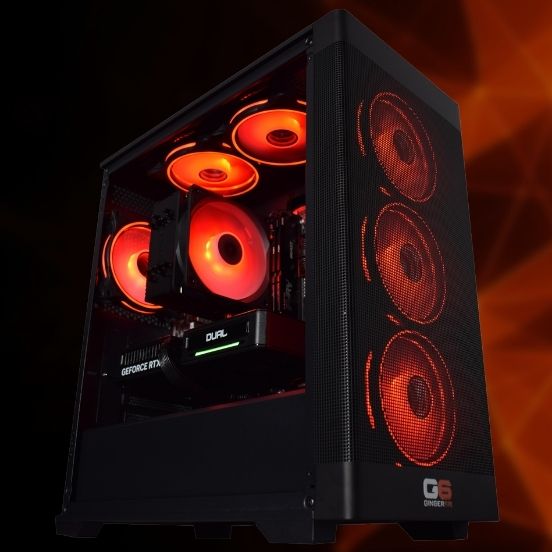
Start here. The Ryzen 5 9600X is six Zen 5 cores at 5.4GHz with 38MB of cache and a 65W power budget, and no 3D V-Cache. It is the processor to fit when the graphics card is the point of the machine and you want the money to land there rather than in the chip. In the G6 Fusion 800 X2 it comes to £1267.99, which is £12.00 less than the slower Ryzen 5 9600 sitting two rows below it in the same dropdown, and that is not a typo. If chasing frame rates is the whole point of the build, the Ryzen 5 7500X3D at £1300.65 will do more than either of them. Every machine is built by hand in Wolverhampton with free UK mainland delivery.
Kevin builds six-core AMD machines most weeks. Call him on 01902 714533, tell him the screen you play on and the card you have in mind, and he will say whether the 9600X is the right chip for it or whether the money belongs in the graphics card.
What the 9600X Is, in Buying Terms
Four numbers, taken from AMD's published specification and checked against the label in our own processor dropdown, which reads 6x 3.90/5.40GHz and agrees with it.
Six Zen 5 cores, twelve threads
Six is the count a modern game engine is comfortable on, and twelve threads is what keeps the machine polite while a game, a browser, a chat client and a capture tool are all open. Six cores was a compromise in 2018 and it is not one now, because the work that used to pile onto the processor has mostly moved to the graphics card. Where six still bites is heavy background encoding and long renders, and that is a core-count problem no clock speed fixes.
3.9GHz base, 5.4GHz boost
The base figure is what all six cores hold together under a sustained load. The boost figure is the top speed one core reaches for a short task, and 5.4GHz is the higher of the two Ryzen 5 chips in the Ryzen 9000 series: the plain Ryzen 5 9600 stops at 5.2GHz. That 200MHz is the entire difference between them, which is worth knowing before anyone quotes it at you as a tier apart.
38MB of cache, and none of it stacked
32MB of L3 plus 6MB of L2. Cache is fast memory sitting on the processor itself, and this is the standard allowance rather than the enlarged one. AMD's X3D chips add a slab of cache beneath the cores, which is worth a great deal in a narrow set of games and close to nothing everywhere else. The 9600X does not have it. That single fact decides most of the buying advice further down this page.
65W on the AM5 socket
TDP is the heat a cooler has to shift, and 65W is modest enough that the standard cooler on a Fusion build runs the chip at its rated speed without the fans making themselves known. It sits on AM5 with DDR5 memory and PCIe 5.0, a platform AMD has committed to for years yet, so a processor swap later does not drag the motherboard with it. It also carries a small Radeon graphics core, which is the reason a machine built on it will still put a picture on the screen with the graphics card taken out.
Is Six Cores Enough? It Depends on the Card in Front of It
A processor is never fast or slow on its own. The only question that matters is whether it is the part that runs out first. Find the graphics card you are buying down the left and the screen you play on across the top, and the answer is in the cell. Orange means the 9600X is the wrong chip and cache is the right one.
| Graphics card | 1080p, up to 144Hz | 1440p, 60Hz to 144Hz | 1080p or 1440p, 165Hz and above | 4K, 60Hz |
|---|---|---|---|---|
| RTX 5060 G6 Fusion 600 X4, Fusion 800 X2 |
The card runs out first | The card runs out first | The card runs out first | The card runs out first |
| RX 9060 XT or RTX 5060 Ti G6 Fusion 800 X1 and X3 |
The card runs out first | The card runs out first | The processor starts to show in the heavy titles | The card runs out first |
| RTX 5070 or RX 9070 G6 Fusion 800 X5 and X6 |
The processor is the limit in competitive titles | Comfortable | Buy cache instead | The card runs out first |
| RTX 5070 Ti and above Apex range |
Buy cache instead | Buy cache instead | Buy cache instead | Not a machine we would fit a Ryzen 5 in |
Three readings of that grid, and the first one is the point. Most of the cells say the graphics card runs out before the processor does. That is not a defence of the 9600X, it is the reason to buy one: on an RTX 5060 or an RTX 5060 Ti machine at 1080p or 1440p, a more expensive processor changes a number you cannot see. The right place for that money is the card, and the card is the part you will feel every single time you sit down.
The orange cells are where we would move you off this chip. They cover the same handful of situations every time: a twitch shooter where you are chasing 240 frames, a sim rig, a strategy campaign in its third hour, a dense city map. In all of them the processor spends its time on tiny repeated lookups that system memory is too slow to keep feeding it, and a larger cache is the one line on a specification sheet that mends it. The Ryzen 5 7500X3D is also a six-core chip, it clocks lower than the 9600X, and in those games it is decisively the better buy. On the G6 Fusion 800 X2 it comes to £1300.65, which is £32.66 over the 9600X, and there is no version of that trade we would argue you out of if frame rates are why you are buying.
And if the total is the thing that is tight, look down rather than sideways. The Ryzen 5 8400F comes as standard on all six G6 Fusion 600 builds with nothing added to the price, and the entry machine is £1069.99 complete with an RTX 3050 in it. Six cores, twelve threads, and enough for a great many people playing at 1080p. The 9600X is a better chip, and if paying the difference means a smaller graphics card, it is the worse decision.
The Faster Chip Is £12.00 Cheaper
On the G6 Fusion 800 range, choosing the Ryzen 5 9600X takes £12.00 off the price and choosing the Ryzen 5 9600 changes nothing. Same base build, same everything else. The 9600X finishes at £1267.99 on the Fusion 800 X2 and the 9600 at £1279.99, and the 9600X is the faster of the two: 5.4GHz against 5.2GHz, 3.9GHz base against 3.8GHz, and otherwise the same six Zen 5 cores and the same 38MB of cache.
We are not going to invent a clever reason for it. Each processor in the dropdown is priced as a difference against the chip the build normally ships with, which on a Fusion 800 is the Ryzen 7 8700F, and that arithmetic happens to land with the faster Ryzen 5 below the slower one. It is real, we read it off the live configurator, and while it stands the answer on a Fusion 800 is the same every time.
So: on a Fusion 800, take the 9600X. There is no argument for paying £12.00 to lose 200MHz, and if a spec list has put the 9600 in front of you, changing it is one click in the processor dropdown. We would rather write that down than take the order.
The question does not arise anywhere else in the range. On the G6 Fusion 600 builds and on the three custom builders the 9600X is a £45.42 upgrade and the 9600 is not offered at all. On the Fusion 1200 range neither appears, because that range starts at eight cores. On any Apex machine neither appears either, because the Apex configurators carry X3D processors only.
If you arrived here from a Fusion 800 specification list that named the plain chip, our Ryzen 5 9600 page covers what that one does and where it stops, and it says the same thing about the £12.00 that this page does.
The Machines That Take the 9600X
No Ginger6 machine carries this chip by default. It is a line in the processor dropdown, and the price of picking it moves with the build. These three are in stock and cover the sensible range.
There is a cheaper route and we would talk you out of it. The G6 Fusion 600 X1 with an RTX 3050 will take the 9600X for £1115.41, and on paper that is the least you can spend to get this processor. It is the wrong place to put the money. Behind a card that size the standard Ryzen 5 8400F is nowhere near being the limiting part, so the £45.42 buys you nothing you would notice, and the same £45.42 moved towards a bigger graphics card changes every frame you see. Either stay on the 8400F at £1069.99 or step up to the X4.
Every other machine in the G6 Fusion 800 range takes the 9600X too, and so does the G6 GTA V 1440p build, with the same £12.00 coming off in each case. It is not offered on the G6 Fusion 1200 range, which starts at eight cores, and it is not offered on any Apex machine, because those configurators carry X3D processors only. Current figures are always in the dropdown on the product page.
Not sure six cores is the right answer? Call Kevin on 01902 714533 or email [email protected] with four things and he will name the chip and the build to put it in, including the times the answer is a cheaper one:
1. The monitor you play on, its resolution and its refresh rate. 2. The three or four games you spend most of your time in. 3. Whether the machine ever has to render, export or encode. 4. The total you have in mind.
Every other part is yours to change on the AMD custom PC builder. 0% finance available via PayPal Pay in 3 on orders over £500. Subject to status.
Six Cores Stopped Being the Compromise, and Cache Became the Argument Instead
For most of the last decade the advice on a Ryzen 5 was to buy more cores if you could stretch to it, and it was good advice, because games were learning to use them and six was the floor rather than the middle. That argument has quietly ended. Engines settled at a thread count six cores and twelve threads serve well, upscaling moved more of the frame onto the graphics card, and the practical result is that on the machines a Ryzen 5 goes into, the processor is rarely what you are waiting for. The interesting question moved. It is no longer how many cores, it is whether the cores have enough cache in front of them.
That is where the 9600X sits, and being honest about it is more useful than defending it. It is the sensible modern six-core: current architecture, the highest clock of the two Ryzen 5 chips in the Ryzen 9000 series, a 65W power budget that keeps a build quiet and leaves headroom in the power supply for the card you will replace first, and a price on a Fusion 800 that is below the machine's own base. What it does not have is the enlarged cache, and in the specific genres where a game hammers the processor for the same small pieces of data over and over, that absence is visible as the dips people describe as stutter. If your week is mostly those genres, this is not your chip, and no amount of clock speed will make it your chip.
Three cases where we would sell you something else, in order of how often we say them. First, if you play competitively at high refresh, or you sit in a sim rig, or your favourite game is a strategy title that slows down as the map fills, buy the Ryzen 5 7500X3D at £1300.65 on the G6 Fusion 800 X2, or step to the Ryzen 7 9800X3D at £1495.99 on the same machine. Cache beats clocks in games and it is not close. Second, if the total is genuinely tight, keep the Ryzen 5 8400F that comes as standard on every G6 Fusion 600 and spend nothing extra at all; £1069.99 gets you a finished machine, and for a 1080p 60Hz to 144Hz screen that is a perfectly good decision. Third, and this one is stranger, do not take the Ryzen 5 9600 on a Fusion 800. It costs £12.00 more than the 9600X for 200MHz less clock speed, and there is no reading of that which favours it.
If the question behind your search was really Intel against AMD at this level rather than which Ryzen 5, that argument has its own page and we will not repeat it here: our guide to whether an i5 is better than a Ryzen 5 for gaming goes through it properly, and the Ryzen 9000 series guide puts all ten of the chips we build with side by side.
How the chip is fitted decides more than which of the three you land on. Memory goes into a Fusion 800 X2 as 16GB DDR5 5200MHz (2x8GB) Dual Channel, a matched pair and never a lone module, because one stick leaves a Ryzen with half the memory bandwidth its designers assumed and the shortfall reads on screen as the uneven frame pacing people pin on the processor. That profile is enabled and proved on our bench, not left dormant for you to trip over in six months. A 65W chip asks very little of the cooler that comes with the build, so the fans sit low in their curve and the room stays quiet; the liquid options at £51.00 and £64.99 are bought for silence rather than for capability. The board is a Gigabyte A620M H and Wi-Fi arrives via the included USB adapter. The finished PC then spends 24 hours under load in the Wolverhampton workshop, since a marginal component is far cheaper to catch on a bench than in a living room. Kevin has been at this since 2001, the Trustpilot score is 4.9 from more than 1100 reviews, a claim inside the 3-year warranty reaches the man who assembled the machine, and where the truthful answer is a cheaper processor, that is what you will be told.
Common Questions About the Ryzen 5 9600X
The Ryzen 5 9600X is a six-core, twelve-thread desktop processor AMD launched on 8 August 2024. It is built on the Zen 5 architecture, holds 32MB of L3 alongside 6MB of L2 for 38MB of cache altogether, has no 3D V-Cache, clocks from a 3.9GHz base to a 5.4GHz boost, and stays inside a 65W power budget. The socket is AM5, the memory is DDR5 and the graphics slot is PCIe 5.0. There is a small Radeon graphics core on the die as well, which is why a machine built on this chip will still show a picture with no graphics card fitted.
Yes, in the machines it belongs in. With an RTX 5060 or an RTX 5060 Ti at 1080p or 1440p the graphics card runs out before the processor does in almost every title, so six Zen 5 cores at 5.4GHz are not the limit and a more expensive chip would change a number you cannot see. Where it is the wrong choice is a 240Hz competitive setup, a simulator rig, or a strategy campaign that gets heavier by the hour, because all three are settled by cache rather than by clock speed. For that reader the Ryzen 5 7500X3D comes to £1300.65 in the same G6 Fusion 800 X2 and it is the better buy.
Because of the way the processor dropdown prices each chip as a difference against the one the build normally ships with. On the G6 Fusion 800 range the 9600X takes £12.00 off the price and the 9600 changes nothing, so the faster chip finishes cheaper: £1267.99 against £1279.99 on the Fusion 800 X2. The two are otherwise the same silicon, six Zen 5 cores with 38MB of cache at 65W, with the X boosting to 5.4GHz against 5.2GHz. Where both appear in the same dropdown, take the 9600X.
None ship with it as standard, so it is chosen in the processor dropdown. On the G6 Fusion 800 range and the G6 GTA V 1440p build it takes £12.00 off the price, which puts the Fusion 800 X2 at £1267.99. On the G6 Fusion 600 range and on the AMD, Ryzen 7000 and Workstation custom builders it adds £45.42, which puts the Fusion 600 X4 at £1225.41. It is not offered on the G6 Fusion 1200 range, which starts at eight cores, or on any Apex machine, because the Apex configurators carry X3D processors only.
The build we would recommend is the G6 Fusion 800 X2 with an RTX 5060 at £1267.99, which is the £1279.99 base machine with £12.00 taken off for this processor. The G6 Fusion 600 X4, also with an RTX 5060, comes to £1225.41. A cheaper route exists on the G6 Fusion 600 X1 at £1115.41 and we would talk you out of it, because behind an RTX 3050 the standard Ryzen 5 8400F is not the limiting part and the £45.42 does more in a bigger graphics card. Every price includes free UK mainland delivery and a 3-year warranty.
In the normal case, yes. Current Nvidia and Radeon cards encode the broadcast themselves, so the processor is left to run the game and six Zen 5 cores manage both without dropping frames. Where six starts to feel thin is CPU encoding at a high bitrate, a heavy capture and overlay setup, or a video export running alongside something else. If that is a regular part of your week, eight cores is the sensible step, and the Ryzen 7 8700F is the standard processor on every G6 Fusion 800 build at no extra cost.
No. 65W is a small amount of heat to move, and the standard cooler that comes with a Fusion build keeps the chip at its rated speed with the fans sitting low in their curve. Liquid cooling is offered at £51.00 for a 240mm radiator and £64.99 for a 360mm, and both are bought for silence or for overclocking headroom rather than because the processor demands them. One footnote worth knowing: AMD puts no cooler in the retail box for this model, which matters if you are buying the chip on its own and makes no difference at all if we are building the machine.
Three years as standard, and longer parts cover can be added at checkout. Before the machine ships it is built by hand at the workshop in Wolverhampton, the memory goes in as a matched pair with its profile switched on and proved, the cooler and fan curve are set for the chip that is in the case, and the finished PC runs under load for a full day and night so a marginal part fails here rather than in your living room. Delivery to UK mainland addresses is free, the Trustpilot score is 4.9 from more than 1100 reviews, and the number on the invoice reaches the person who built it.
The Rest of the Ryzen 5 Shelf
Three chips sit either side of the 9600X in the same dropdown. One is slower and dearer, one is slower and far better at games, and one is free. The Ryzen 9000 series guide puts all ten of the chips we build with in one table.
Ryzen 5 9600
The same six cores 200MHz slower, fitted at no cost across the Fusion 800 range, and £12.00 dearer than this one.
Read the GuideRyzen 5 7500X3D
Six cores with AMD's stacked cache. Lower clocks, higher frame rates, and the chip we move gamers onto.
Read the GuideRyzen 5 8400F
The six cores that cost nothing extra on a Fusion 600, and an honest look at what the £45.42 saving gives up.
Read the GuideStepping up from six Zen 5 cores to eight is the next question most people ask here, and the Ryzen 7 9700X guide answers it with the price attached.
Ready to Build Around the 9600X?
Choose the machine, set the processor in the dropdown, and the build is done by hand here, put under load for a full 24 hours before it is packed, and covered for three years. If the truthful answer for you turns out to be the cheaper chip or the cache chip, that is what Kevin will tell you.