




9800X3D: Specs, Price and Why You Do Not Need the Ones Above It
The short answer: the AMD Ryzen 7 9800X3D is eight Zen 5 cores at 4.7GHz base and 5.2GHz boost, with 96MB of L3 cache and 120W on the AM5 socket. It is the gaming processor most people should buy, and unlike the rest of the X3D range it is not an upgrade option here: it is the standard chip in the G6 Apex 4 at £2599.99 and the G6 Sonic FSX3 at £2344.99, with a sensible configured build from £1495.99. Spending more than this buys frames you would need a counter to see. It buys real time back only if the machine also renders, encodes or compiles. Every one is assembled by hand in Wolverhampton with free UK mainland delivery.
Kevin fits this processor most weeks. Call him on 01902 714533 and he will tell you when the cheaper chip underneath it is the better buy, which is more often than you would expect.
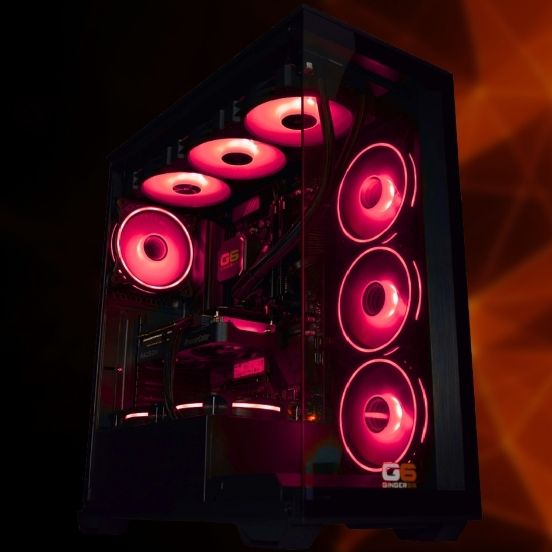
Frames Come From the Cache. Everything Else Comes From Cores.
Nearly every argument about this processor settles itself once you separate those two jobs. Here is each one, and where the 9800X3D lands on it.
The frame rate job, where this chip sits at the top
A game engine does not spread neatly across every core. It spends its time asking for small pieces of data thousands of times a second: where things are, what the world is doing, what happens next. Every time that answer has to come from system memory instead of from the processor itself, the frame waits. AMD's response was to stack a 64MB cache die beneath the cores, taking the L3 pool to 96MB and the total to 104MB once the 8MB of L2 is counted, so far more of that data stays within reach. That is what lifts frame rates and, more usefully, steadies the low ones you feel as stutter. Eight cores at 5.2GHz with that much cache is as good as gaming gets, and nothing above it in the range is meaningfully better at this one job.
The everything-else job, where it is only fine
Rendering a scene, exporting a timeline, compiling a project or running virtual machines is work that does split across cores, and here the 9800X3D has eight of them while a Ryzen 9 9900X3D has twelve and a Ryzen 9 9950X3D has sixteen. Cache barely moves those jobs. Core count close to halves them. So if you sit waiting on exports as a normal part of your week, the money spent stepping up comes back as hours, and we will say so plainly. If you do not, those extra cores idle while you play, and the same money inside the graphics card would have been felt in every game you own. Knowing which of those two people you are is worth more than any benchmark chart on this subject.
The Full 9800X3D Specification
These 9800X3D specs are taken from AMD's own published product specification rather than from our configurator, because where the two disagree the manufacturer wins. On this processor they agree: our option label reads AMD Ryzen 7 9800X3D (8x 4.70/5.20GHz).
| Cores and threads | 8 cores, 16 threads |
| Base clock | 4.7GHz |
| Maximum boost clock | 5.2GHz |
| L3 cache | 96MB, being 32MB on the die plus a 64MB die stacked beneath the cores |
| L2 cache | 8MB, so 104MB of cache in total |
| Architecture | Zen 5, second-generation 3D V-Cache |
| Default TDP | 120W, maximum operating temperature 95C |
| Socket and memory | AM5, DDR5, two memory channels, 256GB maximum |
| Supported memory speed | DDR5-5600 on a two-module kit |
| PCI Express | PCIe 5.0, 24 usable lanes |
| Integrated graphics | AMD Radeon Graphics, 2 cores at 2200MHz, for display output rather than gaming |
| Overclocking | Multiplier open, with AMD EXPO memory profiles and Precision Boost Overdrive |
| Cooler in the box | None. AMD recommends a liquid cooler for best performance |
| Launched | November 2024 |
The Step Up Is Small. The Step Down Is Not Ruinous.
The useful question is never whether the 9800X3D is fast. It is whether the chips either side of it are different enough to move your money. On the G6 Apex 4 both answers sit in the same processor dropdown, so here they are with the prices attached.
Up £36 to the Ryzen 7 9850X3D. Same eight cores, same 96MB of cache, 400MHz more clock. That is worth low single-digit percentages in games and you will not feel it while playing, so where you are in the range decides it. On the Apex 4, where the 360mm liquid cooler and the Wi-Fi 6E board are already fitted and the total is £2599.99, the £36 has nowhere better to go and we would take it. On a Fusion build the same £36 does more in a 360mm liquid cooler at £64.99 or a board with onboard Wi-Fi 6E and Bluetooth at £54.00, so there the answer is no. The detail is on the Ryzen 7 9850X3D page and the two are set against each other on our 9850X3D against 9800X3D comparison.
Down £78 to the Ryzen 7 7800X3D. This is the most useful steer on the page. The 7800X3D is the Zen 4 chip that made this whole family popular, it carries the same stacked-cache advantage, and choosing it takes the Apex 4 to £2521.99. The 9800X3D is the faster of the two, clearly rather than marginally, so take it if the budget allows. If the budget is tight, that £78 does more inside the graphics card than it does inside the processor, and above 1080p the graphics card is what sets your frame rate. Read the Ryzen 7 7800X3D page before you rule it out.
Sideways to a Ryzen 9, only if you work. The Ryzen 9 9900X3D is £100.80 more on the Apex 4 and the Ryzen 9 9950X3D is £208.80 more. In games they land in the same place as the chip you are already looking at, because all three send the game to a cluster of eight cores with the stacked cache. What the money buys is twelve or sixteen cores for the jobs that use them. If you render, stream with processor encoding or compile for a living, it is well spent. If you only game, it is not, and we would rather sell you the cheaper machine and be right about it.
Not sure which of those three you are? That is the call Kevin takes most days on 01902 714533, and it usually takes about four minutes.
The Machines We Build Around the 9800X3D
Two of these carry it as the standard processor rather than as an upgrade, which is the practical difference between this chip and the rest of the X3D family. All three were in stock with a live add-to-cart button when this page was written.
The cheapest 9800X3D machine we sell is one we would talk you out of
For completeness, because you will find it anyway: the G6 Fusion 600 X1 starts at £1069.99 and will take a 9800X3D for £279.60, which comes to £1349.59. That is the cheapest route to this processor anywhere on our site, and it is the wrong buy, because the Fusion 600 X1 is built around an RTX 3050.
Above 1080p the graphics card decides your frame rate, so in that machine the processor would spend most of every frame waiting for a card that cannot keep up. You would be paying a premium for headroom nothing will ever reach, and the frame rate would be the one the RTX 3050 was always going to give you. The £146.40 between that build and the Fusion 800 X2 buys an RTX 5060 instead, and you would feel every penny of it in every game you own. If the total really has to stay near £1350, the honest answer is a cheaper processor and a better card, not this one.
The Whole X3D Range Priced in One Machine
Every line below is the same G6 Fusion 800 X2 with the processor swapped in the dropdown, so the only thing changing is the chip. Read live from the configurator on 30 August 2026, and the current figure is always on the product page.
| Processor | Cores | Configured price | Against the 9800X3D | Take it if |
|---|---|---|---|---|
| Ryzen 7 9700X | 8 / 16 | £1372.99 | −£123.00 | You want eight Zen 5 cores and the games you play are not cache-hungry |
| Ryzen 7 7800X3D | 8 / 16 | £1403.59 | −£92.40 | The budget is tight and the difference is better spent on the graphics card |
| Ryzen 7 9800X3D | 8 / 16 | £1495.99 | the one on this page | You game, and gaming is what the machine is for |
| Ryzen 7 9850X3D | 8 / 16 | £1531.99 | +£36.00 | You are buying a G6 Apex 4 or above, where the cooler and the board are already the good ones. On this Fusion 800 X2 the £36 does more in the cooler |
| Ryzen 9 9950X | 16 / 32 | £1587.19 | +£91.20 | The work matters much more than the games do |
| Ryzen 9 9900X3D | 12 / 24 | £1597.99 | +£102.00 | You game and you render, and twelve cores is enough of the second |
| Ryzen 9 9950X3D | 16 / 32 | £1703.59 | +£207.60 | You game and you render or compile for a living |
Browse the finished machines on the 9800X3D gaming PC page or the wider Ryzen 7 gaming PC page, or specify one from scratch on the AMD custom PC builder.
Three Buyers. Only One Should Spend More.
Read the one that sounds like you and stop there.
Take the 9800X3D
This is you if the demanding thing your PC does is play games, at 1440p or 4K, ideally on a high refresh screen.
Where to stop depends on the machine. On a Fusion build, stop here: the 9850X3D is a few percent, and anything spare belongs in the graphics card or the monitor. On a G6 Apex 4 or above, where the cooler and the board are already the good ones, the £36 step to the 9850X3D is worth taking. The Ryzen 9 chips are no faster in games either way.
Look at a Ryzen 9
This is you if you render, export video, encode or compile most weeks and game in the evening. Twelve or sixteen cores cut those jobs down and game at the same speed.
Where to start: the 9900X3D at £100.80 more on the Apex 4, or our guide to which Ryzen 9 is best for gaming.
Take the 7800X3D
This is you if the total is fixed and something has to give. The 7800X3D saves £78 on the Apex 4 and £92.40 on the Fusion 800 X2, and it is still an excellent gaming processor.
Spend the difference on the graphics card, which decides frame rates at every resolution above 1080p. That is the trade we would make in your position.
Still weighing it up? Call Kevin on 01902 714533 or email [email protected] with four things and he will name the machine and the processor that belongs in it:
1. The games you play most often. 2. Your monitor resolution and refresh rate. 3. Whether you render, stream or edit alongside gaming. 4. Your approximate budget.
Would rather specify it yourself? Every option is on the AMD custom PC builder. 0% finance available via PayPal Pay in 3 on orders over £500. Subject to status.
Why This Became the Default Answer, and What an Unbalanced Build Wastes
When the 9800X3D arrived in November 2024 it ended an argument that had run for two generations. Before it, the fastest gaming chips were the ones you had to make excuses for: locked down, awkward to cool, and clocked lower than their plain siblings because the cache die sat on top of the cores and stood between the heat and the cooler. On Zen 5, AMD turned that sandwich over and put the cache underneath. The cores went back on top where a cooler can reach them, the clock speed came back, and the overclocking restrictions went with it. That is why this processor is both the most sensible eight-core X3D of its generation and the least troublesome one to build a machine around. The faster one is the Ryzen 7 9850X3D, the same eight cores and the same cache with 400MHz more boost, and it costs more for it.
Five of the ten Ryzen 9000 chips we build with carry 3D V-Cache, and this is the one the other four get measured against. It is no longer the newest, and that is precisely why it is the sensible buy rather than the exciting one. The price has settled, the AM5 platform is mature, and the parts above it charge real money for a difference you would need a frame counter to see. When someone rings and asks what to put in a gaming machine at this level, the answer has been the same for a long time now, and it is not a thrilling answer.
The mistake we see far more often is not choosing the wrong processor. It is choosing a good processor and then running out of money before the graphics card. A gaming PC only goes as fast as its slowest part for the job in hand, and above 1080p that part is almost always the card. Put a 9800X3D behind an RTX 3050 and the processor spends the bulk of every frame waiting for the card to finish drawing. You have bought headroom nothing will ever reach, and the frame rate on your screen is the one the RTX 3050 was always going to give you. The same total spent on a lesser chip and a bigger card comes out ahead in every game and at every resolution. That is why the cheapest 9800X3D machine on our site is not the one we recommend, and why the recommendation costs us margin on some orders. It is also the single most common thing Kevin talks people out of on the phone.
The other half of getting this chip right is thermal, and it is easy to underrate. AMD ships it with no cooler in the box and recommends liquid cooling, because an X3D part concentrates its heat into a small area: a cooler that looks perfectly adequate against a 120W figure can still let the clock speed back off in a warm room or a cramped case. The Apex 4 defaults to a 360mm liquid cooler with no cheaper option in the dropdown, and the radiator is positioned so the graphics card is not fighting it for air. Memory goes in as a matched pair in dual channel, never a single stick, since a single stick halves the bandwidth the processor has to work with, and the profile is enabled and confirmed on the bench rather than left for you to find out about later. Then the finished machine runs for a full 24 hours under load in Wolverhampton, which is where a marginal part, an unstable memory profile or a lazy cooler mount announces itself, rather than on your desk three weeks after it arrives.
All of which is why the after-sale question matters as much as the specification does. Kevin has been building these machines since 2001, fits this processor most weeks, and takes the calls himself on 01902 714533. If something needs attention inside the 3-year warranty you speak to the person who built it rather than to a queue, which is a good part of the reason more than 1100 customers have left us a 4.9 on Trustpilot. Delivery to UK mainland addresses is free, and if the honest answer to your question turns out to be the cheaper processor, that is the answer you will get.
Common Questions About the Ryzen 7 9800X3D
The Ryzen 7 9800X3D is an eight-core, sixteen-thread desktop processor AMD launched in November 2024. It runs at 4.7GHz base and 5.2GHz boost, carries 96MB of L3 cache made up of 32MB on the die plus a 64MB die stacked beneath the cores, which comes to 104MB of cache in total once the 8MB of L2 is counted, draws 120W, and fits the AM5 socket alongside DDR5 memory. It is a Zen 5 part with second-generation 3D V-Cache, and it is the gaming processor we recommend to most people.
Yes, and arguably more than at launch, because the price has settled and nothing released since has made it look slow. In games it is within a few percent of the Ryzen 7 9850X3D and level with the sixteen-core Ryzen 9 9950X3D, since all three send the game to a cluster of eight cores with the stacked cache and that cluster is what sets the frame rate. The reason to spend more than this is never frames, it is cores for rendering, encoding or compiling. If gaming is what the machine is for, this is where the sensible money stops.
The G6 Apex 4 with an RTX 5070 Ti at £2599.99 and the G6 Sonic FSX3 with an RTX 5070 at £2344.99 both ship with the 9800X3D as the standard processor rather than as an upgrade. It is also an option in the processor dropdown across the Fusion and Apex ranges: on the G6 Fusion 800 X2 it is a £216.00 upgrade on a £1279.99 base, which comes to £1495.99. Every one is built to order in Wolverhampton and stress-tested for 24 hours before it ships.
The sensible range is £1495.99 to £2599.99. At the bottom is the G6 Fusion 800 X2 with an RTX 5060 and the processor added as an upgrade, at the top is the G6 Apex 4 with an RTX 5070 Ti and the processor as standard, and the G6 Sonic FSX3 sits between them at £2344.99. A cheaper route does exist, since the G6 Fusion 600 X1 will take the chip at £1349.59, and we would talk you out of that one because it pairs this processor with an RTX 3050 that cannot keep up with it. Free UK mainland delivery and three years of cover are included at every one of those prices.
It depends which machine, and for a Ryzen 9 the answer is always no. The 9850X3D is £36 more for 400MHz of extra clock speed, which is worth low single-digit percentages in games. On a G6 Apex 4 or above the 360mm liquid cooler and the Wi-Fi board are already fitted, so there is nothing better waiting for the money and we would take it. On a Fusion build the same £36 does more in a 360mm liquid cooler at £64.99 or a board with onboard Wi-Fi 6E and Bluetooth at £54.00, so there we would not. The Ryzen 9 9900X3D at £100.80 more and the Ryzen 9 9950X3D at £208.80 more are not faster in games at all. What they add is twelve or sixteen cores, which is worth real money if you render, export video or compile, and worth nothing at all if you do not.
For a lot of people, yes. The 7800X3D is the Zen 4 chip that made this family popular, it carries the same stacked-cache advantage, and it is £78 less on the G6 Apex 4 and £92.40 less on the G6 Fusion 800 X2. The 9800X3D is the faster of the two, clearly rather than marginally, so take it if the budget allows. If the budget is tight, a 7800X3D with a bigger graphics card beats a 9800X3D with a smaller one in every game above 1080p, and that is the trade we would make in your position.
AMD ships it with no cooler in the box and recommends a liquid cooler for best performance, and we agree without treating it as compulsory. A good air cooler will run it, because 120W is modest by flagship standards. The catch is that the heat leaves a small area, so a cooler that copes on paper can still let the clock speed back off in a warm room or a cramped case. The G6 Apex 4 is built around a 360mm liquid cooler with no cheaper option in the dropdown and the fan curve set on the bench before dispatch, and on a Fusion build with this processor fitted a cooler upgrade is the first place we would spend the next £50.
Three years as standard on every machine, with longer parts cover available at checkout, and the testing behind the warranty matters more than the certificate does. Each build is assembled by hand in Wolverhampton, cable-managed so the cooler and the graphics card both get clean air, has its memory profile and BIOS settings confirmed, and then runs for a full 24 hours under load so anything marginal fails here rather than at your desk. Delivery to UK mainland addresses is free, and the number on the invoice reaches the person who built the machine.
Before You Settle On It
Ryzen 7 7800X3D
The chip £78 underneath this one, what it gives up, and the times it is the better buy.
Read the Guide9850X3D Against 9800X3D
The £36 question on its own, side by side, with what the extra 400MHz does and does not buy.
Read the ComparisonEvery Ryzen 9000 Chip Explained
The ten chips we build with, side by side, and what each one is genuinely for.
Read the GuideReady to Build Around the 9800X3D?
Pick the machine, or pick the chip in the dropdown of one you like better. Either way it is built by hand in Wolverhampton, run for a full day under load before it is boxed, and covered for three years. If you want a second opinion first, ring the workshop and you will get one.