




AMD Ryzen 8000 Series: The Odd Generation That Sells the Most Machines
The short answer: Ryzen 8000 desktop is a strange generation and it is worth knowing why before you order. These are Zen 4 cores on a single die derived from AMD's laptop and integrated-graphics designs, not the two-die layout used by Ryzen 7000 and Ryzen 9000. That means PCIe 4.0 rather than PCIe 5.0, half the L3 cache, 65W, and no 3D V-Cache anywhere in the line. We build with two of them, both with the integrated graphics switched off, which is exactly why they are cheap and is a non-issue behind a discrete card. They are not exciting chips. They are excellent value in the machines we put them in, and they are the standard processor on fifteen in-stock builds from £1069.99.
If games are the main job and the budget stretches, there is a better place to put the money and this page says so. Call Kevin on 01902 714533 and he will tell you which of the two chips fits, or whether to step past both.
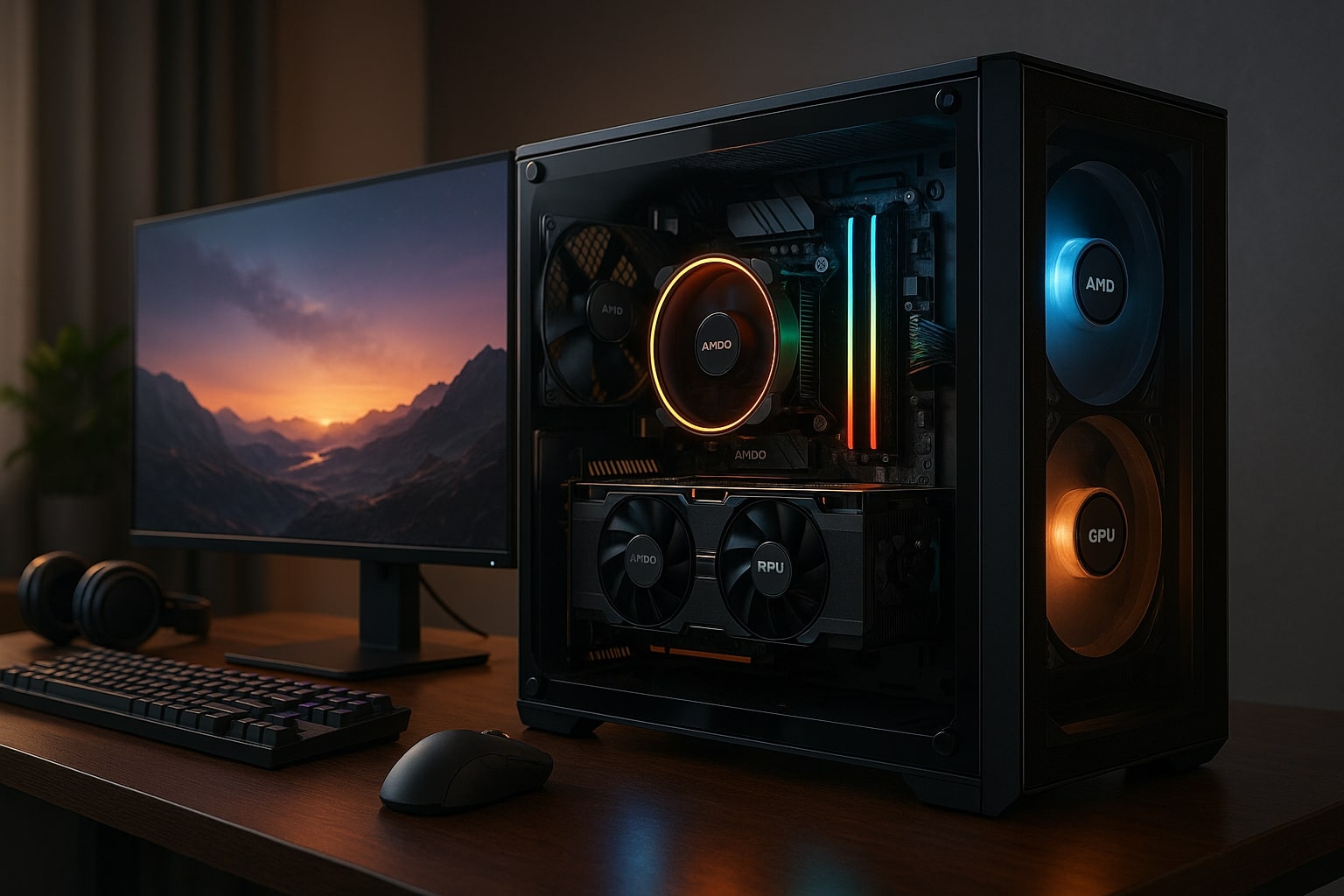
Ryzen 8000 Is Not a Normal Step Between 7000 and 9000
Most guides file this generation between the two either side of it and move on. It does not sit there. Four differences change what the chip is, and a buyer is better off knowing all four.
One die, not two
Ryzen 7000 and Ryzen 9000 split the processor across a compute die and a separate input and output die. Ryzen 8000 desktop puts the lot on one 4nm die that AMD first designed for laptops and integrated-graphics parts, which is why AMD's own codename for it is Phoenix. That single-die layout is where every other difference on this page comes from. It is also why these chips run at 65W and stay quiet under a modest cooler.
PCIe 4.0, and less cache
AMD publishes PCIe 4.0 for both chips where the chiplet parts carry PCIe 5.0, and 16MB of L3 cache where the eight-core Ryzen 7 7700X carries 32MB. Neither is fatal. No current graphics card comes near saturating PCIe 4.0, so the real cost is a lower ceiling on the fastest NVMe drives. The cache is the one that shows up in games, and it is the reason for the honest advice further down this page.
No 3D V-Cache, anywhere in the line
There is no X3D version of a Ryzen 8000 desktop chip and there never was one. On the AM5 socket, stacked cache is the single thing that decides gaming frame rates once the graphics card is sorted, so this is the clearest boundary of what this generation can do. If you want stacked cache at the bottom of the range you have to step across to a Ryzen 7000 part, and we say so plainly rather than talking around it.
The F means the graphics are switched off
Both chips we fit carry an F, and AMD lists both as needing a discrete graphics card. The integrated graphics inherited from the laptop die are disabled, which is precisely why the chips are cheap. In a machine that leaves here with a graphics card in it, that costs you nothing at all. The wider AMD line also has G-suffix parts with the graphics enabled, and those are not chips we build with.
The Whole Ryzen 8000 Choice, on One Screen
Two chips, so this is a short table rather than a padded one. Both prices are the same machine with the processor changed, the G6 Fusion 800 X2, which is the build we price every AMD generation in so the numbers stay comparable across our guides.
Core counts, clock speeds, cache, power and PCIe generation are AMD's published specifications for each processor. The 16 TOPS figure is AMD's published rating for the on-chip AI engine, which Windows features can use and games cannot. Prices are the live configured prices at the time of writing on the G6 Fusion 800 X2, which starts at £1279.99. Prices move, so treat these as a guide and take the live figure from the processor dropdown when you order.
Fifteen In-Stock Machines Ship With a Ryzen 8000 Chip
This is the fact that matters more than any benchmark on this page. These chips are not an upgrade you tick on a form. They are the processor already in the build across the £1000 to £1700 band, which is where most Ginger6 machines are sold.
That is every G6 Fusion 600 build, every G6 Fusion 800 build, both G6 GTA V machines, the G6 ND 1000 and all three AMD configurators, with a Ryzen 8000 chip fitted as standard on each one. Base prices were read live on the product pages at the time of writing, and the current figure is always on the product page itself.
Not Exciting Chips. Excellent Value in the Right Machine.
That sentence is the whole argument and it does not need dressing up. Nobody buys a Ryzen 5 8400F because they read a review of it. They buy a G6 Fusion 600 at £1069.99 or a G6 Fusion 800 at £1279.99 because the graphics card and the price are right, and the processor arrives with it. That is the correct order to make the decision in, and it is why fifteen of our in-stock machines carry one of these two chips. Most Ginger6 customers spending between £1000 and £1800 end up with a Ryzen 8000 processor, and they are right to.
Here is where we talk you out of one. Games respond to cache more than to cores or clock speed, and there is no 3D V-Cache in this generation at all. On any G6 Fusion 600 the Ryzen 5 7500X3D is £84.00 more than the standard Ryzen 5 8400F, and that £84.00 will do more for frame rates than any other tick on the processor list. If gaming is the main job of the machine and the budget can stand it, spend it: our guide to the Ryzen 5 7500X3D covers where it runs out of road. Saying that on a page whose job is partly to sell Ryzen 8000 machines costs us margin on some orders, and it is what Kevin says on the phone.
The one specification worth checking before you order is PCIe 4.0. Every Ryzen 8000 desktop chip runs the graphics slot and the primary drive on PCIe 4.0 where the chiplet generations run PCIe 5.0. For a graphics card this is close to irrelevant, because nothing on sale is limited by PCIe 4.0 bandwidth. For storage it is a genuine ceiling: the fastest current NVMe drives cannot show their full read speed on this platform, which matters for moving very large files and does not matter for loading games. It is worth knowing before you buy rather than finding out afterwards, so we have put it in the specification table rather than in a footnote.
Two more places we would steer you elsewhere. The Fusion 600 X1 at £1069.99 is our entry AMD machine and it pairs the 8400F with an RTX 3050. It is a sound office and light-gaming build, and if modern games at high settings are the point, the X2 at £1154.99 or the X4 at £1179.99 is a much better use of the next hundred pounds. Separately, the Ryzen 7 8700F is a £63.60 option on a Fusion 600, taking the X1 to £1133.59. Two extra cores will not raise your frame rate in a game that is waiting on an RTX 3050. On a Fusion 600, put that money into the graphics card. Buy the eight-core because you are buying a Fusion 800, not the other way round.
Building one properly still matters, whatever the chip cost. Memory goes in as a matched pair in dual channel, never a single stick, because one stick halves the bandwidth the processor has to work with, and the profile is enabled and confirmed on the bench rather than left for you to find. At 65W neither of these chips is hard to cool, which is one of the quiet advantages of the single-die design: the Fusion builds run a standard cooler happily, with a 360mm liquid option at £64.99 if you want a quieter machine. The Fusion range uses a Gigabyte A620M board with Wi-Fi via the included USB adapter, and steps up to a B650M D3HP AX for £54.00 if you would rather have Wi-Fi 6E and Bluetooth onboard. Then every machine runs 24 hours under load in Wolverhampton, which is where a marginal part announces itself rather than on your desk three weeks later.
None of which is a reason to buy from us on its own. The reason is on the phone: 01902 714533 reaches Kevin, who has been building these machines since 2001, fits these two chips more often than any others in the range, and will happily tell you that the machine you were about to order is the wrong one. He is also the person who picks up inside the 3-year warranty if something needs attention two years from now. A processor is a component. A machine is a decision, and this one is easier to make out loud.
Three Budgets, and Where Each One Lands
Pick by what the machine is for and what you can spend. The processor follows from that, and on two of these three it is already fitted.
Six Cores and a Sensible Card
This is the G6 Fusion 600 range, six builds with the Ryzen 5 8400F already fitted and graphics running from an RTX 3050 through an RX 7600, RTX 5050 and RTX 5060 to an RX 9060 XT and an RTX 5060 Ti. Six cores handles every current game at 1080p and high refresh 1440p.
Eight Cores, Bigger Graphics
This is the G6 Fusion 800 range, six builds with the Ryzen 7 8700F already fitted and graphics from an RTX 5060 up to an RX 9070. Take it if something runs alongside the game: streaming, recording, or light editing between sessions.
If Games Are the Whole Point
Neither Ryzen 8000 chip has stacked cache, and that is what frame rates respond to. The Ryzen 5 7500X3D is £84.00 on any Fusion 600, or it comes as standard on the G6 Apex 1 at £1534.99 paired with an RTX 5060.
Want a Ryzen 8000 chip in something that does not ship with one? Both are options on the AMD custom PC builder from £1039.99. If the budget goes further, the Ryzen 7000 range is where stacked cache starts and the Ryzen 9000 range is what to buy new at the top. Or call Kevin on 01902 714533 or email [email protected] with four things:
1. The games you play most often. 2. Your monitor resolution and refresh rate. 3. Whether you stream, record or edit alongside gaming. 4. Your approximate budget.
0% finance available via PayPal Pay in 3 on orders over £500. Subject to status.
Common Questions About Ryzen 8000
Ryzen 8000 is AMD's value tier of AM5 desktop processors, launched in 2024 and built on the same Zen 4 architecture as the Ryzen 7000 range. What separates it is the silicon underneath: where Ryzen 7000 and Ryzen 9000 spread the processor across two dies, Ryzen 8000 desktop puts everything on one 4nm die derived from AMD's laptop and integrated-graphics designs. The wider AMD line also includes G-suffix parts with integrated graphics enabled, which we do not fit. Ginger6 builds with two of them, the six-core Ryzen 5 8400F and the eight-core Ryzen 7 8700F, and both are 65W AM5 chips running DDR5 memory in dual channel.
Because the die came from AMD's laptop and integrated-graphics designs, where PCIe 4.0 was the right trade for power and area. AMD publishes PCIe 4.0 for both the Ryzen 5 8400F and the Ryzen 7 8700F, against PCIe 5.0 on the chiplet Ryzen 7000 and Ryzen 9000 parts. In practice no graphics card on sale comes close to saturating PCIe 4.0, so the cost is a lower ceiling on the fastest NVMe drives rather than lost frame rates. The same die also carries two native USB4 controllers that the chiplet chips do not have, though whether those ports reach the back panel depends on the motherboard. It is worth knowing before you order rather than after.
F means the integrated graphics on the die are switched off. AMD lists both chips as requiring a discrete graphics card, and that is exactly why they cost less than the G-suffix versions of the same silicon. In a Ginger6 machine it changes nothing, because every build leaves here with a graphics card fitted and the display outputs come off that card. The one thing you give up is a spare display output if the graphics card ever fails, which is a diagnostic convenience rather than a feature you would use day to day.
Ryzen 8000 shares the Zen 4 cores of Ryzen 7000 but not the layout. Ryzen 7000 and Ryzen 9000 are chiplet designs with a separate input and output die, PCIe 5.0, and 32MB of L3 cache on a compute die. Ryzen 8000 desktop is a single die with PCIe 4.0 and 16MB of L3. No Ryzen 8000 desktop chip has 3D V-Cache, which is the technology that decides gaming frame rates on this platform. All three generations use the same AM5 socket and the same DDR5 memory, so a Ryzen 8000 machine takes a newer processor later with a BIOS update rather than a new motherboard.
Often not, and this is the honest answer rather than the convenient one. Games respond to cache more than to cores or clock speed, and no Ryzen 8000 chip carries 3D V-Cache. On any G6 Fusion 600 the Ryzen 5 7500X3D is £84.00 more than the standard Ryzen 5 8400F, and that £84.00 will do more for frame rates than anything else on the processor list. If gaming is the point of the machine and the budget can carry it, spend it. If the budget is fixed, the order still holds: a Ryzen 8000 chip behind a bigger graphics card beats a cache chip behind a smaller one.
Six cores handles every current game on its own. Eight cores earns its place when something else is running at the same time: streaming, recording, a browser full of tabs, or light video and photo work between sessions. In practice the question at Ginger6 is which machine you are buying rather than which chip you tick. The six-core is standard across the G6 Fusion 600 range from £1069.99, the eight-core is standard across the G6 Fusion 800 range from £1279.99, and the Fusion 800 builds pair it with larger graphics cards. Pick the machine and the processor comes with it.
Fifteen in-stock machines. The Ryzen 5 8400F is standard on all six G6 Fusion 600 builds from £1069.99 to £1289.99, on the G6 GTA V 144hz at £1194.99 and on the G6 ND 1000 at £1199.99, and it is the base processor on all three AMD configurators from £1039.99. The Ryzen 7 8700F is standard on all six G6 Fusion 800 builds from £1279.99 to £1664.99 and on the G6 GTA V 1440p at £1404.99. That is the £1000 to £1700 band, which is where most Ginger6 machines are sold.
By hand in Wolverhampton, by the people who answer the phone. Memory goes in as a matched pair in dual channel rather than a single stick, because one stick halves the bandwidth the processor has to work with, and the profile is confirmed on the bench. At 65W neither chip is hard to cool, so the Fusion builds run a standard cooler with a 360mm liquid option at £64.99 if you want a quieter machine. The Fusion range uses a Gigabyte A620M board with Wi-Fi via the included USB adapter, and steps up to a B650M D3HP AX for £54.00 for Wi-Fi 6E and Bluetooth onboard. Every machine then runs 24 hours under load before dispatch, ships with a 3-year warranty and free UK mainland delivery, and Ginger6 has been building PCs since 2001 with 4.9 on Trustpilot from more than 1100 reviews.
Go Deeper on the Two We Build With
Ryzen 5 8400F
The six-core chip standard on eight machines and every configurator, what it will and will not keep up with, and who should pay more.
Read the GuideRyzen 7 8700F
Eight cores at 65W, the chip in every Fusion 800, and the honest test for whether the extra two cores are for you.
Read the GuideAll AMD Ryzen Processors
Where Ryzen 8000 sits in the wider AMD range, and the point at which stepping up a generation starts to pay for itself.
Read the GuideReady to Build on Ryzen 8000?
Fifteen of our in-stock machines ship with one of these two chips already fitted, and every one is assembled by hand in Wolverhampton, stress-tested for 24 hours, and backed by a 3-year warranty. The person who answers your call is the person who builds it.