




AMD Ryzen 9 9950X3D: Specs, Price and Who It Is For
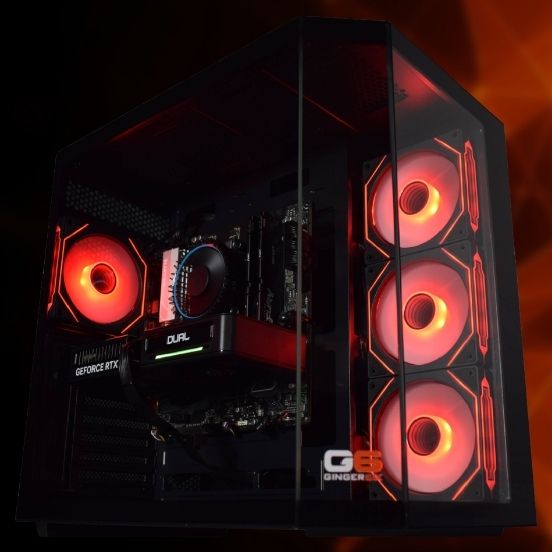
The short answer: sixteen Zen 5 cores, 5.7GHz, and 144MB of cache including AMD's stacked 3D V-Cache. In games it is level with the eight-core Ryzen 7 9800X3D, and in rendering, encoding and compiling it is roughly twice the chip. So it is the right buy when the machine works as well as plays, and the wrong buy if all it does is game. Ginger6 fits it as standard in the G6 Apex 5 with an RTX 5080 at £3209.99, hand-built in Wolverhampton with free UK mainland delivery.
This is a large amount of processor. Call Kevin on 01902 714533, tell him what the machine has to do between games, and he will say whether you need sixteen cores or eight.
What the 9950X3D Is, in Buying Terms
This chip is built differently to the rest of the range, and understanding how explains both what it is good at and what it is not worth paying for.
Sixteen cores in two groups of eight
The chip is two clusters of eight cores. One of them carries the stacked 3D V-Cache and the other runs at higher clock speeds without it. Windows and AMD's chipset driver send games to the cache half and heavy multi-core work across both. When it works, you get gaming speed and sixteen-core throughput from one processor, which is the entire point of the design.
144MB of cache in total
Cache is fast memory on the processor itself. 128MB of L3 plus 16MB of L2 makes 144MB here, against 80MB on the Ryzen 9 9950X that has no stacked cache. Games ask for small pieces of data constantly, so keeping them on the chip lifts frame rates and steadies the low ones. That is why this chip games like an eight-core X3D and the 9950X, with the same core count, does not.
4.3GHz base, 5.7GHz boost
The base clock is what every core holds when all sixteen are working, which is the number that matters during a render or an export. The boost clock is the top speed one core reaches for a short task. 5.7GHz is the highest in the Ryzen 9000 range, and the reason this chip is quick in the everyday work between the heavy jobs as well as during them.
170W, and it wants a serious cooler
TDP is the heat a cooler has to remove, and 170W under a sustained sixteen-core load is real heat rather than a marketing figure. A 360mm liquid cooler is standard on the G6 Apex 5 and Apex 6, and the fan curve is set on the bench so it holds clock speed through a long export rather than backing off after ten minutes. It sits on the AM5 socket with DDR5 memory.
The 9950X3D Against the Two Chips People Compare It To
One has the same gaming speed for less money. The other has the same core count for less money. The 9950X3D is the only one that does both jobs, and you pay for it.
The 9950X3D vs 9950X question comes down to one thing: cache. Prices are the same three processors configured in the same machine, the G6 Fusion 800 X2, read live at the time of writing. Weighing up the twelve and sixteen-core chips against each other? Our guide to which Ryzen 9 is best for gaming goes through the whole tier.
Buy It for the Work. Not for the Frames.
In games, the 9950X3D and the eight-core Ryzen 7 9800X3D are close enough that you would need a frame counter to tell them apart. Both send the game to a cluster of eight cores with 96MB of L3 cache, 64MB of it stacked, and that cluster is what decides the frame rate. Sixteen cores does not make a game faster.
Buy the 9950X3D if the machine also renders, exports, encodes, compiles or runs virtual machines. Those jobs use every core, and sixteen finish them in roughly half the time eight would. If you wait on exports regularly, this chip pays for itself in hours saved rather than frames gained.
Buy it if you stream at a high bitrate with CPU encoding, or run heavy overlays, capture software and a game at once. There is headroom here that an eight-core chip does not have.
Do not buy it if you only game. The Ryzen 7 9800X3D is the same speed in games for a great deal less, and the difference is better spent on the graphics card, which decides frame rates at every resolution above 1080p. We say the same thing on the phone, and it costs us margin on some orders.
Do not buy it for a small case with modest cooling. At 170W under a sustained sixteen-core load, this chip needs the cooler and the airflow to match, which is why we fit it in machines built around 360mm liquid cooling rather than in anything smaller.
Where We Fit the 9950X3D
Two machines carry it as standard and every other AMD build takes it as an option. All four below are in stock and hand-built to order in Wolverhampton.
Not sure sixteen cores is the right answer? Call Kevin on 01902 714533 or email [email protected] with four things and he will tell you honestly, including when the eight-core chip is the better buy:
1. The games you play most often. 2. Your monitor resolution and refresh rate. 3. Whether you stream, record or edit alongside gaming. 4. Your approximate budget.
Every option is also on the AMD custom PC builder. Prices read live at the time of writing, and the current figure is always on the product page. 0% finance available via PayPal Pay in 3 on orders over £500. Subject to status.
The 9950X3D Is Not a Faster Gaming Chip. It Is a Machine That Stops Making You Choose.
For years the AMD range asked a question that had no good answer. If you wanted the best frame rates you bought an eight-core X3D chip and accepted that a video export would take twice as long as it needed to. If you wanted the export you bought a sixteen-core chip and gave up frames in the games that lean hardest on the processor. Plenty of people bought the wrong one, because the marketing on both said flagship and neither said what it was for.
The 9950X3D answers it by being both chips at once. Sixteen cores split into two clusters of eight, one with 96MB of L3 cache, 64MB of it stacked, and one clocked higher without it. The chipset driver steers a game onto the cache cluster, where it behaves like a Ryzen 7 9800X3D, and lets a render or an export spread across all sixteen, where it behaves like a Ryzen 9 9950X. That is a genuinely clever piece of engineering, and it is worth understanding precisely because it tells you when not to buy it: if only one of those two halves matters to you, the chip that does only that half costs less.
Where it earns its price is a specific and recognisable person. Someone who edits video and plays at 1440p or 4K. Someone who renders in Blender and streams. A developer who compiles for twenty minutes at a time and wants the machine to be a serious gaming PC in the evening. For them the sums are simple, because an export that finishes in half the time is time back every working day, and the frame rate is no worse for it. For a person who plays games and does nothing else demanding, the same money in a graphics card buys more of what they will notice, and we would rather sell them that.
Building around this chip takes more care than the eight-core parts. 170W under a sustained sixteen-core load is real heat, and unlike a game, a render holds it there for an hour, so a cooler that copes with a benchmark run can still throttle on the third export of the afternoon. The Apex 5 and Apex 6 run a 360mm liquid cooler as standard, the radiator is mounted so the graphics card is not fighting it for air, and the fan curve is set for a long load rather than a short one. Memory goes in as a matched pair in dual channel, never a single stick, and the profile is enabled and confirmed on the bench, because a sixteen-core chip on an unstable memory profile fails in ways that look like software faults for weeks. Then the machine runs 24 hours under load in Wolverhampton before it ships.
At this price the after-sale question matters as much as the specification. Kevin has been building these machines since 2001, fits this chip most weeks, and takes the calls himself on 01902 714533. If a £3200 machine needs attention inside the 3-year warranty, you speak to the person who built it rather than a support queue, which is the practical reason to buy a machine like this from a builder rather than a box.
Common Questions About the Ryzen 9 9950X3D
The Ryzen 9 9950X3D is a sixteen-core, thirty-two-thread desktop processor released by AMD in March 2025. It runs at 4.3GHz base and 5.7GHz boost, carries 144MB of total cache including AMD's stacked 3D V-Cache, draws 170W, and fits the AM5 socket alongside DDR5 memory. The sixteen cores sit in two clusters of eight, one with the stacked cache for gaming and one clocked higher for everything else.
For gaming alone, no. In games it performs at the same level as the eight-core Ryzen 7 9800X3D, because both send the game to a cluster of eight cores with 96MB of L3 cache, 64MB of it stacked, and that is what sets the frame rate. The 9950X3D is worth the difference when the machine also renders, exports video, encodes or compiles, where sixteen cores finish the job in roughly half the time. If gaming is the only demanding thing the machine does, the money is better spent on the graphics card.
Cache. Both are sixteen-core, thirty-two-thread Zen 5 chips boosting to 5.7GHz at 170W, and in rendering, exporting and compiling they are close. The 9950X3D adds AMD's stacked 3D V-Cache to one cluster of eight cores, taking total cache from 80MB to 144MB, and that is worth a clear step in games and simulation. If the machine never plays a game, the 9950X does the work for less. In the G6 Fusion 800 X2 the 9950X comes to £1587.19 and the 9950X3D to £1703.59.
The G6 Apex 5 with an RTX 5080 at £3209.99 and the G6 Apex 6 with an RTX 5090 at £5889.99 both ship with the 9950X3D as standard. It is also an option in the processor dropdown on every other AMD build: £208.80 on the G6 Apex 4, which comes to £2808.79, and £303.60 on the G6 Fusion 1200 X1, which comes to £1933.59. Every machine is built to order in Wolverhampton and stress-tested for 24 hours before it ships.
A high-end air cooler will run it, and liquid cooling is the sensible choice. At 170W under a sustained sixteen-core load the heat is continuous rather than in short bursts, so a cooler that copes with a benchmark run can still let the chip back off during a long render or export. Ginger6 fits a 360mm liquid cooler as standard on the G6 Apex 5 and Apex 6, which carry this processor, mounts the radiator so the graphics card is not fighting it for air, and sets the fan curve for a long load before dispatch.
32GB DDR5 5200MHz (2x16GB) Dual Channel is the standard fit and is enough for gaming and light creative work. For 4K video editing, 3D rendering or large simulation, a 64GB DDR5 5200MHz (2x32GB) Dual Channel kit is the upgrade worth taking, because running out of memory costs more time than any processor decision saves. Memory always goes in as a matched pair rather than a single stick, since a single stick halves the bandwidth available to a sixteen-core chip.
This processor belongs with a high-end graphics card, so match the monitor to that. With an RTX 5080 in the G6 Apex 5, a 4K panel at 144Hz is the natural fit, and a 1440p screen at 240Hz suits competitive play. With an RTX 5090 in the Apex 6 there is headroom for 4K at higher refresh rates in demanding titles. Adaptive sync, sold as FreeSync or G-Sync, is worth having at either resolution because it removes tearing when frame rates move around, and a display with two or more inputs helps if the machine also does creative work.
Every Ginger6 machine ships with a 3-year warranty as standard, with longer parts cover available at checkout. Before dispatch the build is assembled by hand in Wolverhampton, cable-managed so the cooler and graphics card both get clean air, has its memory profile and BIOS settings confirmed, and runs for a full 24 hours under load so a marginal component fails on the bench rather than at your desk. Delivery to UK mainland addresses is free, and the person who answers 01902 714533 is the person who built it.
Before You Spend That Much
Which Ryzen 9 Is Best for Gaming?
The twelve and sixteen-core chips compared, and an honest look at when a Ryzen 9 is more processor than you need.
Read the GuideRyzen 7 9850X3D
The eight-core X3D chip that games at the same speed for a good deal less, and what the £36 upgrade buys.
Read the GuideEvery Ryzen 9000 Chip Explained
All ten current chips side by side, what each is for, and the price of putting one in a machine.
Read the GuideReady to Build Around the 9950X3D?
Two machines carry it as standard and every other AMD build takes it as an option. All of them are assembled by hand in Wolverhampton, stress-tested for 24 hours, and backed by a 3-year warranty.