




7800X3D: What You Give Up, What You Keep, and Why It Still Sells
The short answer: the AMD Ryzen 7 7800X3D is eight Zen 4 cores at 4.2GHz base and 5.0GHz boost, with 96MB of L3 cache and 120W on the AM5 socket. It is a generation behind, and it is still one of the best gaming processors you can buy, which is why it is the standard chip in three machines we hold in stock: the G6 Apex 2 at £2004.99, the G6 Apex 3 at £2099.99 and the G6 Apex 3 Radeon at £2239.99. If your budget stretches, the Ryzen 7 9800X3D is faster and is the one most people should buy. If it does not, this is the chip that gives up the least. Every build is assembled by hand in Wolverhampton with free UK mainland delivery.
Kevin has fitted this processor for three years and still fits it every week. Call him on 01902 714533 and he will tell you whether to take it or spend the difference on the graphics card, which is the answer more often than not.
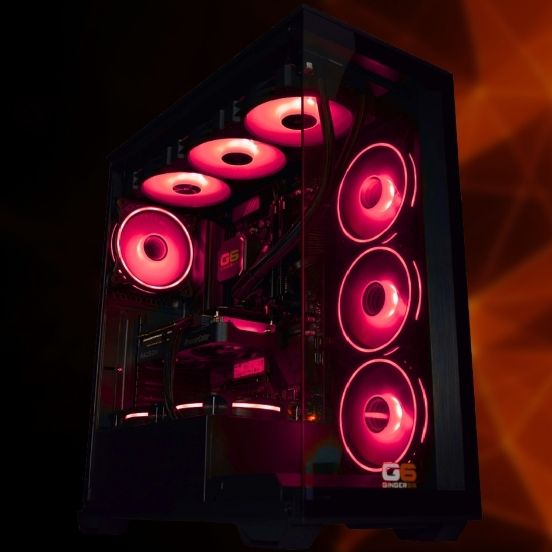
The Cache Sits On Top of the Cores. Everything Odd About This Chip Follows From That.
One physical decision explains the low clock speed, the locked multiplier and the lower temperature ceiling. It is worth two minutes, because it is also why the chip is cheap now.
First-generation 3D V-Cache, stacked above the silicon
The 7800X3D carries 96MB of L3 cache: 32MB on the die itself, plus a separate 64MB die bonded to it. On this generation that extra die is bonded to the top of the cores, so it sits directly in the path between the hottest part of the chip and the cooler. Cache is fast memory the processor keeps within arm's reach, and games are the workload that benefits most, because a game engine asks for small pieces of data thousands of times a second instead of grinding through one long job. Add the 8MB of L2 and there is 104MB of cache in total. That pool is why an eight-core part from 2023 still keeps pace with far more expensive processors in games.
The bill for that: 5.0GHz, and no multiplier to raise it
A layer of silicon between the cores and the cooler is a layer of insulation, and it puts a hard limit on the voltage and heat the part will tolerate. So AMD published it at 4.2GHz base and 5.0GHz boost, where the plain Ryzen 7 7700X of the same generation boosts to 5.4GHz, and set the maximum operating temperature at 89C rather than the 95C its non-stacked siblings run to. AMD does not publish an unlocked multiplier for it either. What you can adjust is EXPO memory profiles, Precision Boost Overdrive and Curve Optimizer, all of which we set on the bench. Zen 5 turned that sandwich over and put the cache underneath the cores, which is exactly why the Ryzen 7 9800X3D clocks higher and came back with its overclocking freed.
The Full 7800X3D Specification
Taken from AMD's own published product specification rather than from our configurator, because where the two disagree the manufacturer wins. On this processor they agree: our option label reads AMD Ryzen 7 7800X3D (8x 4.20/5.00GHz).
| Cores and threads | 8 cores, 16 threads |
| Base clock | 4.2GHz |
| Maximum boost clock | Up to 5.0GHz |
| L3 cache | 96MB, being 32MB on the die plus a 64MB die stacked on top of the cores |
| L2 and L1 cache | 8MB of L2 and 512KB of L1, so 104MB of cache in total |
| Architecture | Zen 4, first-generation 3D V-Cache, codename Raphael |
| Default TDP | 120W, maximum operating temperature 89C |
| Socket and memory | AM5, DDR5, two memory channels, 128GB maximum |
| Supported memory speed | DDR5-5200 on a two-module kit |
| PCI Express | PCIe 5.0, 28 lanes with 24 usable |
| Integrated graphics | AMD Radeon Graphics, 2 cores at 2200MHz, for display output rather than gaming |
| Tuning | AMD EXPO memory profiles, Precision Boost Overdrive and Curve Optimizer |
| Cooler in the box | None. AMD recommends a liquid cooler for optimal performance |
| Launched | 6 April 2023 |
Not the Fastest. Still the Best Price Per Frame.
This is a Zen 4 chip in a Zen 5 world, so the argument for it is not peak performance and we are not going to pretend otherwise. The argument is what a frame costs. The 7800X3D keeps the thing that makes an X3D processor special, the 96MB cache pool, and gives up clock speed and a generation of instructions-per-clock improvement to get the price down.
If you are buying new and the budget stretches, buy the 9800X3D instead. It is faster, clearly rather than marginally, it runs cooler under the same cooler because the cache moved out of the way, and it is what most people should get. On the same G6 Fusion 800 X2 it is £92.40 more. That is the whole gap, and if you can find £92.40 it is the better machine. The detail is on the Ryzen 7 9800X3D page and we would rather you read it before deciding.
If the budget does not stretch, this is the chip that gives up the least. Nobody has yet built a game where a 7800X3D is the reason your frame rate is disappointing. Above 1080p the graphics card sets your frame rate and the processor's job is to stay out of the way, and this one does that at 1440p and at 4K without complaint. The gap to the newer part is real on a benchmark chart and small on a monitor.
If you already own a 5800X3D or a 7800X3D, do not upgrade. A 5800X3D owner on AM4 would be buying a processor, a motherboard and a set of DDR5 memory to gain a fraction of what the same total would gain in a graphics card. A 7800X3D owner would be paying to replace a part that is not holding anything back. We would rather say that on a page about the chip than sell you a machine you did not need.
Not sure which of those three you are? That is a four-minute call on 01902 714533, and it costs you nothing.
The Machines We Build Around the 7800X3D
Three of these carry it as the standard processor rather than as an upgrade, which is unusual for an X3D chip and is the practical reason it is worth a page of its own. Every one was in stock with a live add-to-cart button when this was written.
One oddity worth knowing: the G6 Fusion 1200 X1 ships at £1629.99 with a twelve-core Ryzen 9 7900, and swapping to the 7800X3D costs £1.20, taking it to £1631.19. If that machine is for gaming, make the swap. If it is for rendering or exporting, keep the twelve cores.
There is a cheaper 7800X3D machine, and it is the wrong buy
You will find it anyway, so here it is: the G6 Fusion 600 X1 starts at £1069.99 and will take a 7800X3D, which brings it to £1255.99. That is the cheapest route to this processor anywhere on our site. It is built around an RTX 3050.
A cache-heavy gaming chip earns its money by feeding the graphics card fast enough that the card never waits. Put it in front of an RTX 3050 and you reverse the relationship: the processor spends most of every frame idle while the card finishes drawing, and the frame rate on your screen is the one the RTX 3050 was always going to give you. You would have paid a cache premium for headroom nothing in that machine can reach. The £147.60 between it and the Fusion 800 X2 buys an RTX 5060 instead, and you would feel that in every game you own. If the total genuinely has to stay near that £1255.99, the honest answer is a cheaper processor and a better card.
What the Saved Money Buys Somewhere It Shows
A processor decision is only half a decision. The other half is what the difference does if you spend it elsewhere, and on this chip the answer is unusually clear.
Every line below is the same G6 Fusion 800 X2 with only the processor changed in the dropdown, so nothing else moves. Read live from the configurator on 30 August 2026, and the current figure is always on the product page.
| Processor | Cores | Configured price | Against the 7800X3D | Take it if |
|---|---|---|---|---|
| Ryzen 5 7500X3D | 6 / 12 | £1300.65 | −£102.94 | You play at 1440p and want the cache without paying for eight cores |
| Ryzen 7 7800X3D | 8 / 16 | £1403.59 | the one on this page | You game, and the graphics card is already where you want it |
| Ryzen 7 9800X3D | 8 / 16 | £1495.99 | +£92.40 | The budget stretches. This is the one most people should buy |
| Ryzen 7 9850X3D | 8 / 16 | £1531.99 | +£128.40 | You want the newest eight-core X3D part and the sum is small to you |
Put It in the Graphics Card
The G6 Apex 2 at £2004.99 and the G6 Apex 3 at £2099.99 run the same 7800X3D, the same board and the same cooler. The only difference is an RTX 5060 Ti becoming an RTX 5070.
Why it wins: above 1080p the card sets the frame rate. Ninety-five pounds moved from the chip to the card is the best trade on this page.
Put It in the Cooler
A Fusion 800 X2 ships with a standard cooler, and this chip puts its heat through a layer of stacked cache into a small area. The 360mm liquid upgrade is £64.99, or 240mm at £51.00.
Why it wins: a marginal cooler does not break the machine, it quietly lets the clock speed back off. The Apex builds have the 360mm fitted already.
Or Take Less Processor
The Ryzen 5 7500X3D is six cores with the same stacked-cache trick, and on the Fusion 800 X2 it is £1300.65 against £1403.59. For a lot of 1440p gamers it is genuinely enough.
Why it wins: it frees a hundred pounds for the card. Read the Ryzen 5 7500X3D page before you rule it out, and note the G6 Apex 1 ships with it at £1534.99.
Want the decision made for you? Call Kevin on 01902 714533 or email [email protected] with four things and he will name the machine and the processor that belongs in it:
1. The games you play most often. 2. Your monitor resolution and refresh rate. 3. Whether you render, stream or edit alongside gaming. 4. Your approximate budget.
Would rather specify it yourself? Every option is on the AMD custom PC builder, or browse the finished machines across the AMD gaming PC range. 0% finance available via PayPal Pay in 3 on orders over £500. Subject to status.
A Chip Ages by What Replaces It, Not by How Old It Is
The 7800X3D arrived in April 2023 and spent about eighteen months as the plain right answer for a gaming machine. Then Zen 5 landed, the cache moved underneath the cores, clock speed came back, and this chip stopped being the recommendation. What did not happen is the part everyone forgets: it did not get slower. The games that ran beautifully on it in 2023 still run beautifully on it, and the ones released since have leaned harder on the graphics card rather than on the processor. All that changed is that something better exists and this one costs less than it used to.
That is worth separating from the usual reason people buy last generation, which is that they cannot afford this generation. The interesting case here is the buyer who can afford the newer chip and still does not need it. A gaming PC runs at the speed of whichever part is holding it up, and above 1080p that part is the graphics card in almost every game. Once the processor is fast enough to keep the card fed, more processor buys nothing. The 7800X3D crossed that line three years ago and has not fallen back over it. Spending the difference on the card moves the number that is genuinely limiting you.
Where the argument turns against it is a new build with room in the budget. The Ryzen 7 9800X3D is faster, and the reason is the same physical decision that shapes this whole page: with the cache underneath, the cores sit against the cooler, the clocks are higher, the thermal ceiling is higher and the overclocking restrictions are gone. If you are spending two and a half thousand pounds on a machine you want to keep for five years, take the newer part. It is the honest recommendation even though the 7800X3D is the chip we sell more of, and we would rather lose the sale than have you feel steered.
Fitting one well matters more than the choice between them does. AMD ships this processor with no cooler and recommends liquid cooling, and on a stacked-cache part that advice carries more weight than the 120W figure suggests, because the heat has to travel through the cache die to reach the cooler at all. The Apex 2, Apex 3 and Apex 3 Radeon are built around a 360mm liquid cooler with no cheaper option in the dropdown, and the radiator is placed so the graphics card is not fighting it for air. Memory goes in as a matched pair, dual-channel memory (2x16GB sticks) on the 32GB Apex builds, never a single stick, because one stick halves the bandwidth the processor has to work with, and the profile is set and confirmed on the bench rather than left for you to find. The finished machine then runs for a full 24 hours under load in Wolverhampton, which is where a marginal part or a lazy cooler mount announces itself rather than on your desk a month later. If you are choosing between AM5 and an older AM4 machine at this point, our AM5 against AM4 comparison takes that question on its own terms.
Kevin has been building these machines since 2001, took delivery of the first 7800X3D units the week they landed in the UK, and still answers the phone himself on 01902 714533. If something needs attention inside the 3-year warranty you speak to the person who built it rather than to a queue, which is a fair part of why more than 1100 customers have left us a 4.9 on Trustpilot. Delivery to UK mainland addresses is free, and if the honest answer to your question is a different processor or no new machine at all, that is the answer you will get.
Common Questions About the Ryzen 7 7800X3D
The Ryzen 7 7800X3D is an eight-core, sixteen-thread desktop processor AMD launched on 6 April 2023. It runs at 4.2GHz base and up to 5.0GHz boost, carries 96MB of L3 cache made up of 32MB on the die plus a 64MB die stacked on top of the cores, which comes to 104MB of cache in total once the 8MB of L2 is counted, draws 120W and fits the AM5 socket alongside DDR5 memory. It is a Zen 4 part with first-generation 3D V-Cache, and it is still one of the best gaming processors you can buy.
Yes, on price per frame rather than on peak performance. It is a generation behind the Ryzen 7 9800X3D and it keeps the part that matters for games, the 96MB cache pool, so above 1080p it stays out of the graphics card's way just as well. Nobody has yet built a game where a 7800X3D is the reason a frame rate disappoints. What it gives up is 400MHz of clock speed, a generation of instructions-per-clock improvement and the ability to overclock the multiplier. If your budget stretches to the newer chip, buy that. If it does not, this is the chip that gives up the least.
Three of them. The G6 Apex 2 with an RTX 5060 Ti 16GB at £2004.99, the G6 Apex 3 with an RTX 5070 at £2099.99, and the G6 Apex 3 Radeon with an RX 9070 XT at £2239.99. All three carry a Gigabyte B650M D3HP AX board with Wi-Fi 6E and Bluetooth and a 360mm liquid cooler as standard. The chip is also an option in the dropdown lower down the range: on the G6 Fusion 800 X2 it is a £123.60 upgrade on a £1279.99 base, which comes to £1403.59. Every one is built to order in Wolverhampton and stress-tested for 24 hours before it ships.
The sensible range is £1403.59 to £2239.99. At the bottom is the G6 Fusion 800 X2 with an RTX 5060 and the processor added as an upgrade, then the G6 Apex 2 at £2004.99, the G6 Apex 3 at £2099.99 and the G6 Apex 3 Radeon at £2239.99, all three with the chip as standard. A cheaper route exists, since the G6 Fusion 600 X1 will take it at £1255.99, and we would steer you away from that one because it pairs a cache-heavy gaming chip with an RTX 3050 that cannot use it. Free UK mainland delivery and three years of cover are included at every one of those prices.
If you are buying new and the budget stretches, the 9800X3D. It is faster, clearly rather than marginally, it has more thermal headroom because the cache moved beneath the cores instead of sitting on top of them, and it is the processor most people should get. On the same G6 Fusion 800 X2 the gap is £92.40, which comes to £1495.99 against £1403.59. If finding that £92.40 means taking a smaller graphics card, take the 7800X3D and keep the bigger card, because above 1080p the card is what sets your frame rate.
In both cases, no. A Ryzen 7 5800X3D sits on AM4, so moving to a 7800X3D means a processor, a motherboard and a set of DDR5 memory, and the same total spent on a graphics card would do more for your frame rate in every game. If you already own a 7800X3D you are not being held back by it, and replacing it to gain a fraction is money doing nothing. The upgrade that pays on either machine is the graphics card, and after that a faster drive or more memory. We would rather tell you that than sell you a processor.
Because on this generation the 64MB cache die is bonded to the top of the cores, so it sits between the hottest silicon and the cooler and acts as insulation. That limits the voltage and heat the part will take, which is why AMD published it at 4.2GHz base and 5.0GHz boost where the plain Ryzen 7 7700X of the same generation reaches 5.4GHz, and why its maximum operating temperature is 89C rather than 95C. AMD does not publish an unlocked multiplier for it. What you can tune is EXPO memory profiles, Precision Boost Overdrive and Curve Optimizer, all of which we set and confirm on the bench. Zen 5 moved the cache underneath the cores, which is why the 9800X3D clocks higher and got its overclocking back.
The G6 Apex 2, Apex 3 and Apex 3 Radeon ship with a 360mm liquid cooler and a Gigabyte B650M D3HP AX board carrying Wi-Fi 6E and Bluetooth. On a Fusion build the board is a Gigabyte A620M H with Wi-Fi via the included USB adapter, the standard cooler is fitted by default, and a 360mm liquid cooler is a £64.99 option we would take with this chip because its heat has to pass through the stacked cache to reach the cooler at all. Every machine carries a 3-year warranty, is assembled by hand in Wolverhampton, has its memory profile and BIOS settings confirmed, and runs for a full 24 hours under load before it is boxed. Delivery to UK mainland addresses is free.
Before You Decide On It
Ryzen 7 9800X3D
The chip £92.40 above this one on the same machine, why it clocks higher, and when it is worth the difference.
Read the GuideRyzen 5 7500X3D
Six cores with the same cache trick, £102.94 less on the Fusion 800 X2, and enough for a lot of 1440p gamers.
Read the GuideEvery Ryzen 7000 Chip Explained
The Zen 4 generation in full, what AM5 gave us, and which of these chips are still the default in machines we build today.
Read the GuideIf you are weighing the two Zen 5 eight-core X3D chips above this one against each other, our 9850X3D against 9800X3D comparison prices that gap on nine machines.
Ready to Build Around the 7800X3D?
Three machines carry it as standard and the rest of the range will take it in the dropdown. Whichever you pick, it is assembled by hand in Wolverhampton, run for a full day under load before it is boxed, and covered for three years. If you want a second opinion first, ring the workshop and you will get an honest one.